Tours
More excursions & tours-

Rome Tourist Card
Rome Tourist Card
Snap up the Rome Tourist Card and you'll get everything you need to explore Rome's top highlights including Colosseum, Palatine Hill, Roman Forum and Hop on/off bus. You can even choose the order you see things in.
read more... -
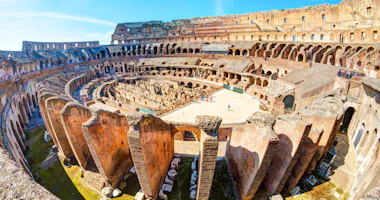
Colosseum, Roman Forum
and Palatine Hill: Skip lineColosseum, Roman Forum
and Palatine Hill: Skip lineSkip the long lines at the Colosseum with this priority-entrance ticket. This ticket will let you bypass the crowds. And after exploring the Colosseum you can head to the Roman Forum + Palatine Hill and enter directly
read more... -

Vatican Museums & Sistine Chapel: Skip The Line
Vatican Museums & Sistine Chapel: Skip The Line
Save time and stress with priority entrance and skip the line. Admire countless masterpieces by Michelangelo, Raphael, Caravaggio, Tiziano, and the Sistine Chapel.
read more... -

Borghese Gallery
Fast TrackBorghese Gallery
Fast TrackGalleria Borghese is located in Villa Borghese park. Admire the architecture and furnishings of this beautiful villa, home to a rich collection of Renaissance art, sculptures, and paintings. Get tickets weeks in advance due to limited capacity.
read more... -

St. Peter's Basilica:
Express Guided TourSt. Peter's Basilica:
Express Guided TourExperience the St. Peter’s Basilica with this express guided tour that includes reserved entrance, allowing you to bypass long lines and make the most of your time.
read more...
Basilica of Saint Sebastian Outside the Walls
The Basilica of St Sebastian Outside the Walls owes its name to the fact that it was located outside the city’s walls built by the Emperor Aurelian. This church is also known as the Basilica of Saint Sebastian near the Catacombs. This basilica is often referred to by the Italian name: San Sebastiano Fuori le Mura. It is located on one of the ancient Roman roads: Via Appia Antica.
Traditionally, the site is a popular pilgrim’s destination. For this reason, during the Jubilee, it has been included in the route of the Seven Churches, a number of worship sites that have to be visited by foot, and all in one day, to be eligible to obtain the indulgence.


In Honor of St. Peter and St. Paul
The site was already well known among the Christian community because of the presence of a large underground burial area, the catacombs. The first church on this site was built during the Christian persecutions, in the III century AD. The church had an important task: the safekeeping of the relics of the apostles and saints Peter and Paul. Those were troubled times in Rome, especially for the frequent sacks and pillaging of the Barbarian populations.
The Emperor Constantine, the first Christian Emperor, built a large basilica on this spot, dedicated to the memory of the apostles, called the Basilica Apostolorum. Some of the remains of the ancient basilica are on display in the interior of the church.
The relics of the apostles were actually kept hidden, for almost three centuries after their martyrdom, in a semi-circular room decorated with marbles and stucco, which lies behind the central apse, called “the Platonia”.
Today, the precious remains of St. Peter and St. Paul are preserved in the basilicas of St. Peter’s and St. Paul’s Outside the Walls.
The Church Today
The basilica was completely reconstructed in the XVII century. The front facade was designed by Giovanni Vasanzio and it features some granite columns once belonging to the former Constantinian basilica.
The interior features a single nave with a carved wooden ceiling. The nave ends with a triumphal arch. On the right hand side there is the chapel of the relics, which preserves a stone that is believed to bear the footprints of Jesus and a dart that pierced Saint Sebastian, together with a fragment of the column to which he was tied to during martyrdom. One of the most interesting artworks is definitely the famous Salvador Mundi, a marble bust depicting Jesus the Saviour: it’s the last masterpiece created by the great Gian Lorenzo Bernini. The bust was recently recovered, in 2001, in the monastery adjacent to the church. The sculpture was crafted when the Baroque artist was already eighty years old, and bequeathed to his friend and patron queen Christine of Sweden.·
History and Cult of Saint Sebastian
Saint Sebastian is a famous Christian martyr. At the beginning of the III century AD., during the reign of Diocletian, he was serving as the captain of the Praetorian Guard, which had the important task to protect the life of the Emperor. Therefore, Praetorians had to be extremely trusted and faithful to the Emperor.
But Sebastian was a Christian, probably since its birth, and Diocletian is remembered as one of the most indomitable persecutors of the new monotheist cult, which somehow undermined the powers and authority of the emperor. Thanks to his intelligence and skill, Sebastian was appointed Praetorian. Apparently, Diocletian did not know that he was a Christian. As a member of the high military ranks, Sebastian could discreetly help the Christians that were imprisoned by the emperor. His influence grew to the point that he helped to convert many members of the court.·
Once his actions were discovered, Diocletian sentenced him to be tortured and shot to death by arrows. After the execution, left for dead, Sebastian miraculously survived. When he could stand back on his feet, he went back to Imperial palace and confronted Diocletian, expressing his reprimand on Diocletian’s brutal persecution of Christians. This time the emperor had the brave Sebastian killed by flogging. His body was thrown in the city’s sewage (the Cloaca Maxima), but, at night, the corpse was eventually recovered by members of the Christian community, and carried to the catacombs.
The devotion to Sebastian has been very popular since the third century, and, even when other catacombs were abandoned during the Middle Ages, pilgrims have kept on traveling here to honor the memory of the saint. His relics are preserved in an urn below the main altar. He is widely considered the third saint patron of the city of Rome, after the saints Peter and Paul.
A Gateway to the Catacombs
The area was known as “ad catacumbas”, which means “near the hollows”, because of the presence of tuff stone mines. Because this became one of the major underground burial sites for the Christian community, the name “catacombs” started to identify all the subterranean cemeteries. These catacombs are accessible from a passageway on the square in front of the church.
This is probably the only catacomb site that was visited and well known throughout the centuries. And, because everybody knew its exact location, thieves and looters have come here several times, stealing many of the tombs’ artifacts and other items that could be easily sold. That’s why many of the saints’ relics were moved to churches closer to the center of the city, as the trade of those items was one of the most ludicrous businesses during the Middle Ages. Still, these catacombs remain one of the most stunning evidences of the way in which the Early Christians wanted to keep a strong sense of community not only during life, but even in the afterlife.·
The entrance to the church is free, while a ticket must be purchased to visit the catacombs.·
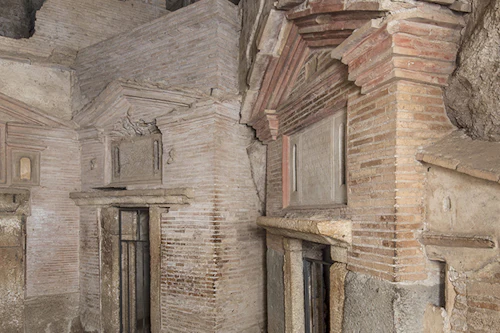
Catacombs of San Sebastiano: Entry Ticket + Guided Tour
Catacombs of San Sebastiano: Entry Ticket + Guided Tour
On this expertly guided tour of the Catacombs of San Sebastiano, you'll experience the full beauty, faith and memory of the catacombs, created between the end of the second and the beginning of the third century AD. The space was used for burial and funeral commemorations in the Christian...

You might also like

Basilica of San Clemente
The Basilica of San Clemente is a complex layer of churches whose ruins date back from the twelfth century. Built by the cardinal priest of San Clemente
Read more...
Basilica of St Mary Major
Basilica of St. Mary Major, known in Italian as the Basilica Papale di Santa Maria Maggiore, it is the largest Roman Catholic Marian Church in Rome.
Read more...
St Peter’s Basilica
St Peter’s Basilica Basilica - The Papal Basilica of Saint Peter in the Vatican, officially known in Italian as Basilica Papale di San Pietro in Vaticano.
Read more...
Villa Borghese
Villa Borghese is a great landscape garden in Rome, containing a number of buildings, museums, and attractions. It is the second largest public park in Rome
Read more...