Tours
More excursions & tours-

Rome Tourist Card
Rome Tourist Card
Snap up the Rome Tourist Card and you'll get everything you need to explore Rome's top highlights including Colosseum, Palatine Hill, Roman Forum and Hop on/off bus. You can even choose the order you see things in.
read more... -
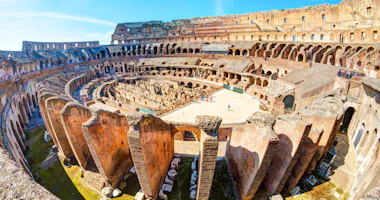
Colosseum, Roman Forum
and Palatine Hill: Skip lineColosseum, Roman Forum
and Palatine Hill: Skip lineSkip the long lines at the Colosseum with this priority-entrance ticket. This ticket will let you bypass the crowds. And after exploring the Colosseum you can head to the Roman Forum + Palatine Hill and enter directly
read more... -

Vatican Museums & Sistine Chapel: Skip The Line
Vatican Museums & Sistine Chapel: Skip The Line
Save time and stress with priority entrance and skip the line. Admire countless masterpieces by Michelangelo, Raphael, Caravaggio, Tiziano, and the Sistine Chapel.
read more... -

Borghese Gallery
Fast TrackBorghese Gallery
Fast TrackGalleria Borghese is located in Villa Borghese park. Admire the architecture and furnishings of this beautiful villa, home to a rich collection of Renaissance art, sculptures, and paintings. Get tickets weeks in advance due to limited capacity.
read more... -

St. Peter's Basilica:
Express Guided TourSt. Peter's Basilica:
Express Guided TourExperience the St. Peter’s Basilica with this express guided tour that includes reserved entrance, allowing you to bypass long lines and make the most of your time.
read more...
The Roman Forum
Roman Forum
Current visitor information
Checked
Plan your visit
Plan for earlier access and uneven ground. SUPER sites admit visitors only until one hour before park closing; many paths are rocky or uneven, so wear appropriate footwear.
How many times have you heard that "all roads lead to Rome"? In ancient Rome this was not only true, but all the main roads built before and during the Imperial era have an exact starting point, called "Migliaio d’oro" (golden milestone). It is next to the Temple of Saturn, in the middle of what is the largest historical site in the world today: the Roman Forum.
Let’s take a walk around the most lively, symbolical and stunning remains of Roman civilization. Originally a burial site, the Forum became the center of political and institutional life, business and trade, and a had a strong symbolic connotation. When Rome became the greatest empire of its time, the Romans were well aware of that. Every monument, temple and triumphal arch that was built here, was made to celebrate Rome, its leaders, armies and people.

What to See
The Roman Forum is probably the largest historical site in the world, and a continual excavation work in progress for generations of archaeologists. Let’s briefly outline some of the main monuments you will be able to admire during your visit.
The Arch of Titus
This triumphal arch was built in 81 AD by the Emperor Domitian. His brother Titus had achieved important victories, in particular with the suppression of the rebellion of the people of the Roman region of Judaea. In fact, on one of the panels adorning the monument, there is a marble deep relief depicting the army carrying the menorah and other spoils from the temple of Jerusalem, after the fall of the city. Titus was deified, a common practice among great Roman emperors.
The arch was converted into a fortified tower during the Middle Ages, while at the beginning of the nineteenth century, the architect Valadier (the same who designed and built Piazza del Popolo and other important landmarks of Rome) restored the inscriptions and other parts using travertine masonry.
The Temple of Venus and Rome
Considered the largest in ancient Rome, this temple was dedicated to the deities of Venus and Rome. It was a project of the Emperor Hadrian, and was completed in 141 AD, after 20 years of construction, under his successor, Antoninus Pius. The temple was surrounded by 60 columns. Today, only the foundations remain. On one side, there is the Basilica of Santa Francesca Romana, built in the ninth century AD, while on the other side, there is a large terrace from where you can admire a nice view of the Colosseum from a short distance. Definitely a nice spot for a great souvenir picture!

Colosseum Arena Floor & Roman Forum + Guided Tour
Colosseum Arena Floor & Roman Forum + Guided Tour
This enthralling tour reveals the majestic Colosseum, the ancient Roman Forum, and the verdant Palatine Hill, all brought to life by stories from a knowledgeable local guide. The first stop is the Roman Forum. Once the bustling hub of ancient Rome, this site is teeming with the remnants of...

Roma Pass: 72-Hr Public Transport Access + Entry to 1 or 2 Attractions
Roma Pass: 72-Hr Public Transport Access + Entry to 1 or 2 Attractions
When you're crafty and clever, Italians applaud your _furbizia_. And with this pass you’ll definitely feel like a sly insider. It gives you full access to Rome’s public transport system, free entry to one or two of Rome’s key attractions (depending on which option you pick) and discounts for...

Colosseum, Roman Forum & Palatine Hill
Colosseum, Roman Forum & Palatine Hill
Skip the long lines at the Colosseum with this priority-entrance ticket. This ticket will let you bypass the crowds. And after exploring the Colosseum you can head to the area of the Roman Forum and the Palatine Hill.
The Temple of Vesta
Nearby, are the remains of the temple dedicated to Vesta, which was the residence of the vestal virgins, young girls consecrated to the deity. The building was the home of the Sacred Fire, which had to burn perpetually. The temple was officially closed by the emperor Teodosio in 391 AD. Ironically, the temple was still in pristine condition in 1500, when, among with other buildings of the forum, it was demolished and its marbles and columns were used as recycled construction materials.


The Arch of Septimius Severus
This monumental arch was built to celebrate the Emperor Septimius Severius and Rome's victorious wars in Arabic countries and in Parthia (the region where Iraq and Iran are today). It was built in 203 AD. Originally, the inscriptions gave homage to the Emperor and his two sons, Caracalla and Geta. But, after the death of Septimius, Caracalla ordered the killing of Geta and “edited” all the inscriptions containing the name of the assassinated brother from all the monuments in Rome: a process called “damnation memoriae”, namely the perpetual condemnation of memory. The arch is built in bricks and travertine, and completely covered in marble.
The most remarkable elements of the arch are four large panels measuring almost four by five meters each, and depicting important phases of the war. To testify the decline that the city had to suffer, it suffices to say that during the Middle Ages, there were accounts stating that the central part of the semi-buried arch was converted into a barber shop. The arch was dug up between 1803 and 1898, and finally given back its original dignity as one of the most well preserved triumphal arches of ancient times.
The Basilica of Massenzio
This basilica is named after the emperor Massenzio, whom started to build it in the early years of 300 AD, and was completed by Costantine. Originally, on the site of the basilica there was a large spice warehouse. The basilica covered an area of 100 by 65 meters. In the western apse, there was a monumental statue, in a seated posture, of Costantine (12 meters in height), whose remains are now visible in the Capitoline Museums. Recent studies show that the statue probably depicted Massenzio, but was later adapted to represent the facial features of Costantine.


The Massenzio’s Basilica was home to the most important public administrative offices of the city, such as the Secretarium Senatus (the court house for trials against the senators), and the urban prefecture. In the square of Santa Maria Maggiore, there is the last “surviving” column of the central part of the basilica. It is 14.5 meters in height and, originally, was one of the eight columns which supported the monumental central vault.
“
What is a Basilica?
The term “basilica” is of Greek origin, and in ancient Rome was a rectangular building with two or more lateral naves, which was used for political meetings, public assemblies, business and trade. They were also used as court houses. A basilica had a central role in the citizens' lives. That’s why Christians were inspired by this type of architecture when they started building their places of worship.
The Temple of Saturn
The remains of this temple testify to the greatness of the early Republican era of Rome. This building was the home of the state’s treasure, the town’s archives, and a scale for the metal’s official weighing. It was also the place where citizens could have access to newly approved laws and official communications.
Just to give you an idea of the Forum’s original magnificence, here’s a video with a 3D reconstruction of all the main buildings.·
The Forum’s Main Activities and Purpose in the Imperial Age
During the period of maximum splendor of the city, the forum was the center of all the main activities. There were markets, administrative buildings, political meeting venues, tribunals and temples. It was also the main business and trade district. After a victorious war campaign, it was used as a venue for military parades, when the army would march under the triumphal arches to celebrate their achievements and, at the same time, purify their souls.
Many significant events took place here including the crowning of the Emperor Augustus. Also, the Senate’s meetings would decide on whether to start a war or try to resolve political conflicts in a peaceful way, which immensely affected the fate of many populations of the known world. And, interestingly, it already was a popular destination for people coming from nearby villages and towns, looking for business opportunities, but also for entertainment. Therefore, we can say that Rome had tourism in its DNA, almost from day one!
Augustus and the Forum
There is a famous quote by Augustus that says: "I found Rome a city of bricks and left it a city of marble". And that is very true, indeed. Many of the buildings were made out of wood and bricks, especially most of the houses surrounding the forum area. The emperor replaced them with colossal marble temples: the Temple of Castor and Pollux, the Temple of Saturn, the Temple of Vesta, the Temple of Venus and Roma, the Temple of Antoninus and Faustina, the Temple of Caesar, the Temple of Vespasian and Titus, and the Temple of Concord. According to him, by doing so, the Romans would be closer to the gods and they would be favored with bountiful lives.


The Forum and the City Across the Centuries
The Forum is located at the spot of the first settlement of Rome. In the sixth century BC, the city was just a village, then it became a kingdom, a republic and, finally an empire. Almost every chief, king, consul or emperor has enriched this place with a monument, a temple, a statue or a public building. The remains we can see today are the result of these complicated layers of history. Having said that, most of the best known landmarks belong to the last period of active use of the forum, namely the Imperial era.
When Rome went into decline, it was sacked by the Barbarians, and its population was strongly reduced. Just to give you an idea, during the golden age of the Empire, Rome consisted of a million and a half residents. Also, the Forum and the city had suffered huge fires which had partly damaged many of the buildings. In the sixth century AD, after more than a hundred years of war and food shortages, that number shrunk to about 30,000 people. From the early Middle Ages, there was a slow but steady recovery and increase in numbers.
But, sadly, the area where the magnificent Forum stood was in complete decline, and used as cows’ pastures. To make things even worse, many of the marble coverings which adorned the monuments, were removed by the Vatican administration, to be used in churches and other areas of the city. Some of the buildings were systematically demolished, and the construction materials were used to build private residences. The first Pope, who recognized the importance of preserving the area, and at the same time started to reconstruct the city, was Urban V, around 1350. At the beginning of the twentieth century, Rome was still a relatively small urban center, with about half a million residents. Today, with its population of 3 million people, it’s the biggest city in Italy.
The Forum and the Palatine Hill
The Forum and the adjacent Palatine Hill form a large, single, historical site which can both be accessed via a single ticket. The entrance to the Palatine Hill is on Via di San Gregorio, or directly from the Forum. The Palatine, one of the seven hills of ancient Rome, is home to some of the oldest remains of the city. Here, you can admire the residences of Emperors such as Augustus, Tiberius and Septimius Severius and several temples. Also, you’ll be able to visit ancient dwellings carved into stone, which are believed to be part of the very first settlement.
·
How To Get To the Roman Forum
Today, flocks of sightseers (around 5 millions each year) visit the Roman Forum because it gives them a unique time travel experience. It is located between the Capitol and the Colosseum, with entrances at Via dei Fori Imperiali and Piazza del Colosseo. You can arrive here getting the Subway/Metro B, stepping off at the Colosseo station. The Forum is open daily from 9 a.m. to one hour before sunset.

FAQ
-
Where is the Roman Forum?
The Roman Forum can be found in the old center of Rome, next to Mount Palatine and near the Colosseum
-
When was the Roman Forum built?
The first buildings on the Roman Forum were built 500 BC. After that, this place grew into the bustling center of Rome
-
Is the Roman Forum free to access?
The Roman Forum is not accessible for free. You can walk around it and take a look at the Roman Forum
-
why is there so little left of the Roman Forum?
There is so little left of the Forumanum for several reasons. There was once a major fire in this center. After that, the buildings suffered a lot from earthquakes and floods. Eventually people started to loot. Stones were removed from the old buildings to be used for new structures.
-
What does Forum Romanum look like in the evening?
The Roman Forum has a completely different atmosphere at night than during the day. After dark, many of Rome's landmarks are illuminated. This also applies to the Roman Forum
You might also like

The Colosseum
The Colosseum or is the most famous and largest monument of the Roman Empire. Originally a place of entertainment, especially known for it's gladiator battles, it's Rome's most famous landmark and one of the seven world wonders.
Read more...
Palatine Hill
The Palatine Hill is one of the Seven Hills of Rome. Previously, several emperors lived here. Here, you can visit the House of Augustus, the House of Livia, Nero's Cryptoporticus and the Domitian's secret passage.
Read more...
The Vatican Museums & Tickets
The Vatican museum consists of several pontifical museums and galleries which are open for public viewing. Several popes founded the museums
Read more...
Villa Borghese
Villa Borghese is a great landscape garden in Rome, containing a number of buildings, museums, and attractions. It is the second largest public park in Rome
Read more...