Tours
More excursions & tours-

Rome Tourist Card
Rome Tourist Card
Snap up the Rome Tourist Card and you'll get everything you need to explore Rome's top highlights including Colosseum, Palatine Hill, Roman Forum and Hop on/off bus. You can even choose the order you see things in.
read more... -
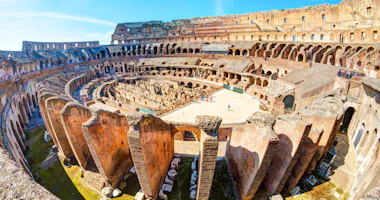
Colosseum, Roman Forum
and Palatine Hill: Skip lineColosseum, Roman Forum
and Palatine Hill: Skip lineSkip the long lines at the Colosseum with this priority-entrance ticket. This ticket will let you bypass the crowds. And after exploring the Colosseum you can head to the Roman Forum + Palatine Hill and enter directly
read more... -

Vatican Museums & Sistine Chapel: Skip The Line
Vatican Museums & Sistine Chapel: Skip The Line
Save time and stress with priority entrance and skip the line. Admire countless masterpieces by Michelangelo, Raphael, Caravaggio, Tiziano, and the Sistine Chapel.
read more... -

Borghese Gallery
Fast TrackBorghese Gallery
Fast TrackGalleria Borghese is located in Villa Borghese park. Admire the architecture and furnishings of this beautiful villa, home to a rich collection of Renaissance art, sculptures, and paintings. Get tickets weeks in advance due to limited capacity.
read more... -

St. Peter's Basilica:
Express Guided TourSt. Peter's Basilica:
Express Guided TourExperience the St. Peter’s Basilica with this express guided tour that includes reserved entrance, allowing you to bypass long lines and make the most of your time.
read more...
Aqueduct Park
Not all parks in Rome are flooded with tourists. Actually, Rome is one of the greenest cities in Europe and there are many parks that have not yet been discovered by the occasional visitors. The Aqueduct Park is a good example of an interesting site which is completely off the tourist track. The park is mainly used by joggers and there are a couple of private sports clubs.
In the park you will find the massive remains of a number of ancient aqueducts that were built during the Roman Empire. The park is about 240 hectares and it is located in the South East side of the city. In ancient times, it was a real crossroads for the water supply heading to the urban area.

Water supply was considered essential in every Roman city plan. The state-of-the-art mastery gained by the architects has been used not only in Rome, but in plenty of cities founded during all over the Roman Empire. The aqueducts were so robust, that many have survived until the present day. You can find remains of those structures in Italy, Spain, France, Germany, Turkey and Israel. They were built using overlapping arches. The water ran in a groove at the top, and the system worked using the force of gravity. Some of those aqueducts run for tens of kilometers with a gradient of only about 30 cm for each kilometer of length. This highly specialized and precise technology remained unsurpassed for more than 1,000 years after the Roman Empire’s decline.
Unfortunately, this area has been neglected for many years and, from the ‘50s, it was partially occupied with a slum. In the ‘70s, the barracks and unauthorized small houses were removed, and the site officially became a park. Still, the area has had its ups and downs with regards to maintenance, until it became part of the wider complex of the Appia Antica Park. In Italian, the name of this park is Parco degli Acquedotti .


On top of the aqueducts, there are a number of ruins of towers, villas, tombs and also some parts of a Roman road.
The Park’s Attractions
The Aqueducts
Vetus Aqueduct
The Vetus Aqueduct is one of the oldest aqueducts in this park.·The water of this aqueduct came directly from the river Aniene (near the town of Tivoli).
Tepula Aqueduct
The Tepula Aqueduct has been built during the Republican era, in 125 BC. Its name “Tepula” is Latin for “tepid”, because the temperature of the water at the source was at about 17° C.
Anio Novus Aqueduct
The Anio Novus Aqueduct is one of the longest aqueducts of this park with a length of about 87 km. However, most of it is not visible, as·approximately 73 km of this structure runs below the ground. Its construction began under the emperor Caligola in 38 AD and ended under Claudio in 52 AD.
Claudius Aqueduct
Thanks to the technology used for its construction, the Claudius Aqueduct is considered one of the most important aqueducts of the Eternal City. The section that you’ll be able to see in the park is actually the most well preserved of its entire original 46 km of length. It was built between 38 and 52 AD by the emperors Caligola and Claudio, in the same years of the aqueduct Avio Novus, as the water supply had to be increased because of the rapid growth of the city.
Julia Aqueduct
The Julia Aqueduct was made by a building contractor and loyal friend of the Emperor Augustus in 33 BC. That’s why the structure is dedicated to the emperor’s family, the Gens Julia. The water comes from the town of Grottaferrata, located at approximately 20 km South East of Rome.
Aqua Marcia Aqueduct
The Aqua Marcia Aqueduct’s route runs partly below the ground and partly above the ground over arches.·It’s about 90 km long and it was built by the Praetor Quinto Marcio Re in 144 BC.
Felice Aqueduct (Aqua Felix)
Compared with the other aqueducts, this one is relatively modern, as it has been built in 1586 by will of Pope Sixtus V. Through this aqueduct, the Roman hills of Viminale, Quirinale and Esquilino, together with the splendid Villa Montalto, had a constant supply of clean water. The Montalto palace was a monumental mansion in the center of Rome, privately owned by the pope’s family, which was later demolished to build the Termini Station and residential buildings in the Rione of Castro Pretorio.


Other Attractions
Casale Roma Vecchia
Casale Roma Vecchia's main structure dates back to the year 1200. Originally this house/tower was used for defense purposes and to control the nearby Aqueducts Claudio and Marcio. Later, it was converted into a farm.
Torre del Fiscale
Built around 1200 – 1300, and about 30 meters in height, this is a well preserved tower of the Middle Ages. It is situated at the intersection between five different aqueducts. The tower was built as a lookout post to guard the landed estates and the crops of the noble Roman families . The area around it, is named after this building, and it’s called Parco di Tor Fiscale.
Villa dei Sette Bassi
This large archaeological site has been only partially investigated. It was one of the largest complexes of the Roman suburbs. It was built in the second century AD and included three large buildings and a huge hippodrome-garden and it was inhabited up to the fourth century. The villa is not accessible to the visitors yet.
Via Latina
This ancient road connected Rome to the city of Capua, in the Campania region. The road was 240 km long and it’s considered one of the most ancient routes in the Lazio area: the Etruscans had used the same path to colonize areas of the Campania region. In the park, you’ll find some parts of the old via Latina road built during the Roman Empire, along with tombs, farms, Roman villas and medieval towers.
Fosso Acqua Mariana
Fosso Acqua Mariana is an artificial ditch that was used as an alternative to the aqueducts, mainly for the Saint John in Lateran orchards irrigation. Fosso Acqua Mariana was built in 1122 by Pope Calixtus II.

Torre di Guardia su Cisterna
Torre di Guardia su Cisterna is a tower built in 1200 to as a guard post for the Fosso Acqua Mariana.
Casale Del Sellaretto
This old roadhouse was built next to an old railroad by the Pope Pius IX in 1856, and it was mainly used as a store at the track. When the new railroad Rome-Naples was finished, this building fell into disrepair.
Cisterna della Villa delle Vignacce
Next to the Aqua Marcia Aqueduct and to the ancient Villa delle Vignacce, it is possible to visit the ruins of the two-storey tank that used to supply water to the nearby large complex.
How to Get to The Aqueduct Park and Travel Tips
You can arrive here by subway (Metro Line A – Anagnina Direction) and get off at the stop called Giulio Agricola. Then, walk down Viale Giulio Agricola Street. One of the park’s entrances is at the end of the street. We suggest that you visit this park during the day, and avoid walking around it after sunset. The park is very large, with no fencing or gates, poor artificial lighting (especially in some areas) and no surveillance. Some people may take their dog off the leash for a run, so be aware of that, especially if you are traveling with children.

FAQ
-
What is the Aqueduct Park?
The Aqueduct Park is a large park located in the area South East of Rome. Here, you will be able to see the remains of many aqueducts built during the Roman Empire and other sites such as buildings, tombs and a medieval tower.
-
Why are the Roman aqueducts famous?
The state-of-the-art mastery gained by the Roman architects has been used not only in Rome, but in plenty of cities founded during the Roman Empire. These structures were built using extremely precise technology, and the water ran at the top of the arches, in a groove with a very small gradient of approximately 30 cm for each kilometer. The aqueducts had a length of tens of kilometers.
-
How do I get to the Aqueduct Park?
You can arrive at the Aqueduct Park by subway (Metro Line A – Anagnina Direction) and get off at the Giulio Agricola stop. Then, walk down the road and you’ll reach one of the park’s entrances.
You might also like

Appia Antica Park
The title Appia Antica Park is just a shortened version of its complete name Parco Regionale dell’Appia Antica. The area is known for its rich collection of ancient treasures, archaeological remains and ruins. You can likewise find some monuments along Via Appia and the park area. Each of the monuments pictures the rich history of Rome.
Read more...
The Colosseum
The Colosseum or is the most famous and largest monument of the Roman Empire. Originally a place of entertainment, especially known for it's gladiator battles, it's Rome's most famous landmark and one of the seven world wonders.
Read more...
Gladiator School
Always wanted to know what it’s like to be gladiator? On the Gladiator School, you will learn all about the life of the gladiators of ancient Rome.
Read more...
St Peter’s Basilica
St Peter’s Basilica Basilica - The Papal Basilica of Saint Peter in the Vatican, officially known in Italian as Basilica Papale di San Pietro in Vaticano.
Read more...