Tours
More excursions & tours-

Rome Tourist Card
Rome Tourist Card
Snap up the Rome Tourist Card and you'll get everything you need to explore Rome's top highlights including Colosseum, Palatine Hill, Roman Forum and Hop on/off bus. You can even choose the order you see things in.
read more... -
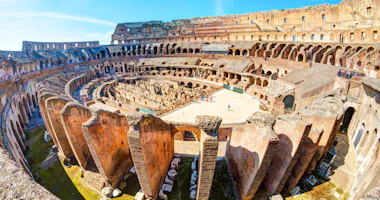
Colosseum, Roman Forum
and Palatine Hill: Skip lineColosseum, Roman Forum
and Palatine Hill: Skip lineSkip the long lines at the Colosseum with this priority-entrance ticket. This ticket will let you bypass the crowds. And after exploring the Colosseum you can head to the Roman Forum + Palatine Hill and enter directly
read more... -

Vatican Museums & Sistine Chapel: Skip The Line
Vatican Museums & Sistine Chapel: Skip The Line
Save time and stress with priority entrance and skip the line. Admire countless masterpieces by Michelangelo, Raphael, Caravaggio, Tiziano, and the Sistine Chapel.
read more... -

Borghese Gallery
Fast TrackBorghese Gallery
Fast TrackGalleria Borghese is located in Villa Borghese park. Admire the architecture and furnishings of this beautiful villa, home to a rich collection of Renaissance art, sculptures, and paintings. Get tickets weeks in advance due to limited capacity.
read more... -

St. Peter's Basilica:
Express Guided TourSt. Peter's Basilica:
Express Guided TourExperience the St. Peter’s Basilica with this express guided tour that includes reserved entrance, allowing you to bypass long lines and make the most of your time.
read more...
Basilica of Saint Paul Outside the Walls
Saint Paul is one of the four papal basilicas and the second largest after Saint Peter’s. It was built on the burial site of Saint Paul. Since
1980, this impressive place of worship, famous destination of pilgrimage since 300 AD, has been declared a World Heritage Site by UNESCO.
It is a very important basilica for both Christianity and art history. Here you can admire not only the many works of art, including a
complete collection of medallions with portraits of the popes, but also the beautiful external areas, with the large facade mosaics with
golden reflections, colonnades, gardens and a stunning cloister. The basilica is also at the center of a famous prophecy, as you will read
below.
History: the Basilica of the Popes
This basilica has very ancient origins. The main feature of this church, as well as its enormous size, is the Byzantine character of both the
structure and the decorations. According to tradition, the basilica was built at the exact spot where Paul’s disciple, Timothy, buried the
body of the saint, who had suffered martyrdom in a nearby area, where the Abbey of the Three Fountains stands today. Recent excavations have
confirmed this hypothesis, bringing to light the remains of a large ancient burial site.
In 330 AD, Pope Sylvester built the first
(small) church here, oriented towards Jerusalem. Just a few years later, in 390, another basilica was inaugurated. This was much larger, to
welcome the many pilgrims who came to pay homage to the saint from all the corners of the known world. The church was built under the reign of
three different emperors. Over the centuries, it has been enriched with works of art and partially restored, although the shape of the
structure has remained as it originally was. Even after a huge fire destroyed much of the basilica, and as outlined in a chapter below, the
popes rebuilt it almost exactly as it was before.


Before Entering
Outside the church, there is a large four-sided portico with a marble statue of Saint Paul in the middle. This part of the complex is quite
recent as it was entirely erected at the beginning of the twentieth century. At the top, you can admire the mosaics of the facade, depicting
Christ, Saint Peter and Paul and the prophets. The bell tower, instead, is older, as it was built in the nineteenth century.
What to See in The Church
This exceptionally large church (130 meters long, 65 meters wide and 30 meters high) is a shining and massive evidence of the magnificence not
only of sacred art, but of art history in general. It is divided into 5 naves and has a Latin cross floor plan. It is impossible, in this
article, to list all the artworks inside! We’ve listed below the ones you can’t miss.
The portraits of the popes -
If you look up, above the arches of the side aisles, you will see a decoration formed by circular mosaics. There are 256 of them, and they
depict all the popes, from Saint Peter to Pope Francis. These are realistic portraits only for the popes from the year 1500 onward.
The triumphal arch - This ancient mosaic dates back to the Byzantine period. The patron of this artwork representing the
Christ Pantocrator, with Peter and Paul below, was Galla Placidia, a powerful and famous Roman noblewoman, daughter of an emperor,
granddaughter of three others, wife of a Visigoth king and later of a Roman emperor. He was regent during the reign of his son, Emperor
Valentinian III, crowned at the age of six.
Apse - The apse depicts Christ the Redeemer with the Gospels, Saints
Peter and Paul, the apostles and Pope Honorius III. This mosaic was made in 1200, under his pontificate.
Side chapels - On the sides of the apse there are four chapels. The second from the left is called the Chapel of the Blessed
Sacrament. In this chapel you can admire a wooden crucifix of the thirteenth century. Near the last chapel on the right, there is the oratory
of San Giuliano, with precious original frescoes of the twelfth century.
Ciborium - The ciborium, which is the
canopy structure built above the main altar, has miraculously been preserved practically intact to the present day. It was designed in Gothic
style by Arnolfo di Cambio in the year 1285.
The tomb of Saint Paul, The chains and the eternal flame - In the
center, under the ciborium, is the site of the tomb of Saint Paul, which is located a little lower than floor level. Here you will also find
an illuminated shrine containing the chains used to hold Saint Paul prisoner before martyrdom. On the side, there is a lantern with a burning
flame. It is called "eternal flame" and is always kept alight by the Benedictine monks, to witness· their living faith.
The cloister - Next to the basilica, there is the beautiful cloister built by the Cosmati and the Vassalletto families, who were the famous Roman marble artists, at the beginning of the thirteenth century. It is a very peaceful place, adorned with carefully tended flowerbeds. It is one of the absolute masterpieces of this type of architectural structure, especially thanks to the efforts of Pietro Vassalletto, who also built the cloister of San Giovanni in Laterano. Engraved on the walls, there are six examples of Triplice Cinta (three concentric squares). It is a symbol whose origin is not very clear, but seems to be associated with the shape of the Gardens of Solomon. It also has an esoteric value, and is often found in religious buildings associated with strong energy powers. The symbol corresponds to the board game Tria, very popular since the Middle Ages.

The Prophecy of the monk Malachi
Malachi was a Benedictine monk who lived in Ireland in the 12th century. Four hundred years after his death, a document attributed to him was made public. On this ancient parchment, he described all the future popes, starting with Celestine II, his contemporary, with brief but incredibly faithful annotations. Malachi stated that, after Celestine, there would have been another 111 popes. After the last pope of this list, the Church will come to an end, and possibly the world will follow!·
Incredibly, the circles featuring the portraits of the popes in the basilica, from Celestino onward, are actually 111, and the last one is occupied by the portrait of Pope Francis. However, in reality, this portrait is placed at the end of a nave: just around the corner there are other empty round shapes ready to accommodate the faces of the next popes. Furthermore, historians have many doubts about the authenticity of the Malachi parchment: it could be a forgery skillfully made in the sixteenth century.
Fire and reconstruction
In 1823, a worker who was carrying out some repair work on the roof of the basilica, accidentally left a fire unattended which he used to light
the workplace. A fire broke out and, for several hours, enveloped the basilica in flames, burning much of it. Some parts were miraculously
saved, such as the triumphal arch, the ciborium, the apse mosaics and the cloister.
It was such a traumatic event for the Roman
Catholic community that the reigning pope, who was gravely ill, was not made aware of the disaster. His successor, Leo XIII, began the
complicated and costly reconstruction work. The ambitious project was to rebuild the basilica exactly as it was.
A fundraiser was
announced to which many monarchs joined, including the Tsar of Russia, the King of France and the Netherlands, and the Viceroy of Egypt. Some
of them, like the tsar, also sent precious and rare building materials, such as lapis lazuli for mosaics and alabaster columns. The new
basilica was inaugurated in 1854, but restoration continued until 1930. In 2006, some renovation work on the floors brought to light the
sarcophagus of Saint Paul, which is now visible. It is located near the altar, but just below the floor level of the basilica.
The archaeological site
In the area just outside the church, you can visit an archaeological site discovered in 2008. There are the remains of an ancient monastery for pilgrims, dating back to 600 A.D. Here you can also see a gallery where there are exhibits from the ancient basilica and artworks found during the excavations. There is also an art gallery, where paintings, wooden tables, sacred objects and a precious Bible from the Carolingian period (9th century) are exhibited.
Opening times, how to get there, useful information
The address of the basilica is Piazzale San Paolo 1. It is open every day, from 7:00 until 19:00. Free admission. The cloister and
archaeological site are open from 9:00 to 17:30. To visit these areas, the price of the ticket (full) is € 4, while the discounted price is €
3.
Getting to the Basilica of St. Paul Outside the Walls· (in Italian, San Paolo Fuori le Mura) is very simple.
By Metro: Take
Line B and disembark at "San Paolo Basilica".
By bus: Take line 23 and disembark at "Ostiense/LGTS San Paolo".
Inside the
complex of the basilica, there is a souvenir shop with many items, including mosaics, coins and reproductions of artworks featured inside the
church. There is also a large and modern cafeteria, perfect for a break with a good coffee or a snack.
Upon request, it is possible
to book guided tours for groups for a fee. Inside the church, you can take photographs, both with your camera and with your mobile phone, but
without a tripod.
St Paul Outside the Walls
Current visitor information
Checked
Plan your visit
The official timetable page conflicts with stale 19:00 times elsewhere on the same site. Recheck before visiting.

You might also like

Basilica of Saint Sebastian Outside the Walls
The Basilica of St Sebastian Outside the Walls owes its name to the fact that it was located outside the city’s walls built by the Emperor Aurelian. This church is also known as the Basilica of Saint Sebastian near the Catacombs. This basilica is often referred to by the Italian name: San Sebastiano Fuori le Mura. It is located on one of the ancient Roman roads: Via Appia Antica.
Read more...
Churches in Rome
Although the Vatican is a separate and independent country today, Rome still remains popular for its many churches spread throughout the city.
Read more...
St John Lateran Archbasilica
Of the four papal basilicas in Rome, the St. John Lateran Archbasilica is the oldest. It is also considered as the main basilica and one of the seven pilgrimage churches.
Read more...
Monuments Rome
Rome has proven itself to be a strong city, judging by its monuments that have withstood the test of time. Not all monuments in Rome are that lucky
Read more...