Tours
More excursions & tours-

Rome Tourist Card
Rome Tourist Card
Snap up the Rome Tourist Card and you'll get everything you need to explore Rome's top highlights including Colosseum, Palatine Hill, Roman Forum and Hop on/off bus. You can even choose the order you see things in.
read more... -
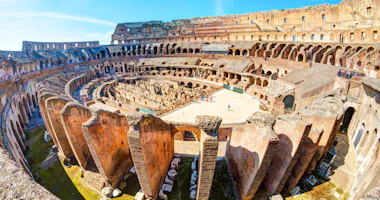
Colosseum, Roman Forum
and Palatine Hill: Skip lineColosseum, Roman Forum
and Palatine Hill: Skip lineSkip the long lines at the Colosseum with this priority-entrance ticket. This ticket will let you bypass the crowds. And after exploring the Colosseum you can head to the Roman Forum + Palatine Hill and enter directly
read more... -

Vatican Museums & Sistine Chapel: Skip The Line
Vatican Museums & Sistine Chapel: Skip The Line
Save time and stress with priority entrance and skip the line. Admire countless masterpieces by Michelangelo, Raphael, Caravaggio, Tiziano, and the Sistine Chapel.
read more... -

Borghese Gallery
Fast TrackBorghese Gallery
Fast TrackGalleria Borghese is located in Villa Borghese park. Admire the architecture and furnishings of this beautiful villa, home to a rich collection of Renaissance art, sculptures, and paintings. Get tickets weeks in advance due to limited capacity.
read more... -

St. Peter's Basilica:
Express Guided TourSt. Peter's Basilica:
Express Guided TourExperience the St. Peter’s Basilica with this express guided tour that includes reserved entrance, allowing you to bypass long lines and make the most of your time.
read more...
Trevi District
The Rione Trevi (Trevi District) is one of the most ancient areas of the city, and very popular among tourist, thanks to its famous landmarks and charming roads and squares. Trevi is traditionally divided into a lower part (near the Tiber) and an upper part, where there is the residence of the President of the Republic, on the Quirinal Hill.
Trevi is mainly known for its world famous monumental fountain, but once you arrive here, you’ll discover that this central area offers plenty of interesting monuments, palaces and churches, as well as shopping streets, cafes and restaurant. Far from being a “monumental” district, in Trevi there is always a lively and exciting atmosphere.
The name “Trevi” derives from the Latin word “trivium”, which refers to a square where the original three main roads of the district converged, between the end of Via dei Crociferi and the Trevi Fountain square.
Palaces
- Palazzo Odescalchi
- Palazzo Colonna, where the gallery Colonna is situated
- Quirinal Palace
- Palazzo Barberini
- Palazzo Antamoro
Fountains
Fontana del Tritone
Squares
- Piazza di Trevi
- Piazza dei Crociferi
- Piazza Santi Apostoli
- Piazza della Pilotta
- Quirinal Square
- Piazza Barberini
Other sites
Galleria Sciarra, a public passage that is partially closed with a chain as an ornament.
Chapel Madonna dell’Archetto


Brief Historical Notes
During the Roman empire, the lower part of Trevi consisted of an intricate group of streets and alleys with shops and apartment buildings. Since the beginning, the upper part was home to an affluent residential area. One of the most famous inhabitants of this district was Michelangelo Buonarroti, who lived here during the second half of his life.
Being densely populated, Trevi underwent many changes and renovations during the centuries. Most of the palaces and churches that you can find in the lower part were built during the Renaissance, while the hill was completely reshaped in the XIX century, becoming the residency of the President and home to many government offices.
The Ancient City of Water: One of Rome’s Best Kept Secrets
When walking around the streets of Trevi, you would be surprised to learn that, under the street’s pavement, there are the remains of the ancient aqueduct Virgo, built back in the 1st century a.C. Even if it underwent many renovations, the aqueduct is still in use, and provides water to the Trevi Fountain and other monuments in the city.
During the Nineties, it was discovered a vast and complex underground archaeological site which lies approximately under the fountain and its surrounding streets. This area has recently been open to the public, and includes the remains of buildings, a domus (a private aristocratic villa) and a large collecting tank. Some of those ruins belong to Nero’s era. The site has been named “The City of Water” (La città dell’acqua).

What to see in the Trevi District
For detailed information about the Trevi fountain, please visit our dedicated page here.
FOUNTAIN OF THE TRITON (Barberini Square) - This fountain is perhaps one of the most underrated works by Gian Lorenzo Bernini. It was commissioned by Pope Urbano Barberini in 1625. The idea was to bring a marine-themed work of art within an urban context. The statue depicts a newt (triton) kneeling on a large sea shell, which in turn is supported by four dolphins. The genius of the artist is right here: if you look closely, it is only the interweaving of the dolphin tails that supports the whole heavy statue!
SANTA MARIA IN TRIVIO (Piazza dei Crociferi) - When facing the Trevi fountain, look at your left, towards the small Piazza dei Crociferi square . Here, set in a building on the square, there is the Baroque facade of the Church Holy Mary in Trivio. The church was built between 1500 and 1600, and it’s fairly small compared to many churches in Rome. Still, if the portals are open, it’s definitely worth a visit, as it features remarkable works of art, some of them older than the church itself, such as the Holy Mary adorning the altar (1400) and a Venetian School style crucifix (1350).
CHURCH OF ST. VINCENZO AND ANASTASIO - Situated in Trevi Square, the facade of this church overlooks the famous fountain. This church has early medieval origins, but was completely rebuilt in the Baroque period. Its façade is one of the most characteristic of this artistic current. Entirely made of travertine marble, it is composed of various orders of columns and shrines. It was made on behalf of Cardinal Julius Mazzarini, and that is why there is also a bust of him here. In addition, the only case in Rome, there is also the statue of a lay woman, Ortensia Mancini, his favorite niece. The church has been consecrated for Orthodox worship since 2002.
SANTI APOSTOLI BASILICA (S.S. APOSTOLI) - The first gigantic basilica to be built on this large widening adjacent to Venezia Square dates back to the fourth century, but it was destroyed by a violent earthquake in the middle of 1300. The reconstruction took place in 1400. The church was then entirely rebuilt in 1700, but the structure of the porch is still that of the fifteenth century. The façade and the interior are in solemn neoclassical style. The most famous works of art are certainly the ceiling frescoes (by Baciccio) and the impressive funeral monument of Pope Clement XIV, designed by Canova. In a cavity between the walls of the church and those of an adjacent building, some valuable fifteenth-century frescoes can be seen. Those had been partially damaged by the floods of the river, and walled up when the building was reconstructed.
SANCTUARY OF THE MADONNA THE ARCH (MADONNA DELL’ ARCHETTO) - This very small, stunning chapel is located in Via di San Marcello. Built in 1800, it preserves an image of the Madonna made at the end of 1600, which was once located in a narrow alley nearby. This image, according to tradition, was seen rolling its eyes by various witnesses in 1796. The rich neo-Renaissance style is unique in its kind, with precious metals and marble. The paintings inside the chapel are by Costantino Brumidi, who later also designed the Washington Capitol building’s dome. This tiny sanctuary, which can accommodate only a few people, opens every day at 6 pm, for the recitation of the Holy Rosary .

QUIRINAL PALACE - The palace is currently the residence of the President of the Italian Republic. During the Roman empire, in the area of the Quirinal Palace, there were villas and residential buildings of the aristocracy. Starting from 1500, a palace was built here that was used as a papal residence. The current structure was built between 1600 and 1700, with important interventions also during 1800. With the unification of Italy, the palace became the residence of the king. The interior furnishings were embellished with Rococo decorations and furniture, according to the style of the time. The palace features several halls and chapels. Inside the palace there are important collections of paintings, statues, tapestries, porcelain and antique furniture and clocks.
The building has an area of about 110,000 square meters (about 20 times larger than the White House). In the great Pauline Chapel, four conclaves were held for the election of the pope. When official lunches are held on the lookout, instead that in one of the dining halls, a secondary kitchen is used. The main kitchen, in fact, is so far from the Belvedere, that the food would get cold by the time it reaches the tables! A last interesting fact: inside a hall, there is the largest carpet in Europe: it has an area of 300 square meters and weighs 900 kilos. At the moment, it has been temporarily removed to be restored.
The presidential palace is open to visitors. The tour must be booked at least 5 days in advance, and has a very low cost: only 1.50 euro. When booking, you will need to provide your name, which will be shown on your ticket. Unfortunately, the tour is only in Italian. Tickets can be booked on the official website of the Quirinale.
If you happen to be in the upper area of Trevi just before sunset, don’t miss the opportunity to admire a breathtaking Roman sunset from the terrace situated in front of the Quirinal Palace. Here, you can also see an obelisk originally placed in the mausoleum of Emperor Augustus and the splendid group of statues of the Dioscuri (Castor and Pollux), proceeding from a thermal complex built by the Emperor Constantine.

OTHER PALACES - Other impressive palaces are the Palace of the Odescalchi, Palace Rospigliosi Antamoro and Palazzo Poli, situated right at the back of the Trevi fountain. One of the halls of the building was chosen by composer Franz Liszt for the debut of his “Sinfonia Dantesca”. He reckoned that the background sound of the Trevi fountain’s waters added character to the melody of his musical composition.
TREVI DISTRICT SQUARES - When exploring this area, you’ll come across some of the most characteristic squares in Rome, some of which we have already mentioned here, such as Piazza Trevi, Piazza dei Crociferi, the Quirinal Square, Piazza S.S. Apostoli and Barberini Square.
We suggest also suggest to include in your itinerary the square called Piazza della Pilotta. This site it is named after the ball game (pelota ), played by hitting the ball with bare hands or with a bat, making it bounce against the wall. On this square, there was a regulation-size playing court. This game was very popular in Rome from the sixteenth century onward.
How to get to the Trevi district
This central district is very well connected to the rest of the city. You can arrive to Trevi with the subway (Line A – Barberini stop), or with one of the many buses stopping in Via del Tritone or Via Veneto. In Via del Tritone and in Piazza S. Silvestro square you can also find taxi stops.
Travel Tips
Trevi is teeming with shops, cafeterias and restaurants. The large roads such as Via del Corso and Via del Tritone feature famous brands and franchise stores. For a taste of an Italian mega store dedicated to fashion and accessories, you can visit La Rinascente in Via del Tritone: 8 floors of shopping therapy and a panoramic terrace you don’t want to miss, where you can enjoy an aperitif or a snack. In Piazza Colonna, there is the gallery of the same name, with a great selection of designer shops. Along the smaller alleys, among the ubiquitous souvenir shops , you can also find many charming traditional artisan boutiques.

You might also like

Trevi fountain
The Trevi Fountain is the largest and most famous fountain in Rome with a width of 22 meters and height 26 meters. It is situated at the Piazza di Trevi
Read more...
Neighborhoods Rome
Rome’s entire neighborhood has a sum total of 18 districts. The historical centre, which is roughly just four percent of the area of the entire city.
Read more...
Trastevere – The Timeless Charm of Rome’s Most Authentic District
Trastevere is the go-to-spot if you wish to have a glimpse of the old days of the people of Rome. Mornings in Trastevere are nothing but calm and superb, while at night it's the perfect place to go out for a nice meal or drink.
Read more...
Monuments Rome
Rome has proven itself to be a strong city, judging by its monuments that have withstood the test of time. Not all monuments in Rome are that lucky
Read more...