Tours
More excursions & tours-

Rome Tourist Card
Rome Tourist Card
Snap up the Rome Tourist Card and you'll get everything you need to explore Rome's top highlights including Colosseum, Palatine Hill, Roman Forum and Hop on/off bus. You can even choose the order you see things in.
read more... -
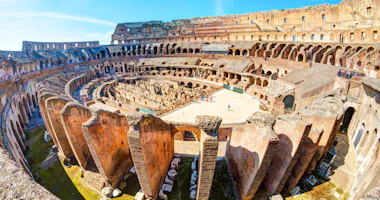
Colosseum, Roman Forum
and Palatine Hill: Skip lineColosseum, Roman Forum
and Palatine Hill: Skip lineSkip the long lines at the Colosseum with this priority-entrance ticket. This ticket will let you bypass the crowds. And after exploring the Colosseum you can head to the Roman Forum + Palatine Hill and enter directly
read more... -

Vatican Museums & Sistine Chapel: Skip The Line
Vatican Museums & Sistine Chapel: Skip The Line
Save time and stress with priority entrance and skip the line. Admire countless masterpieces by Michelangelo, Raphael, Caravaggio, Tiziano, and the Sistine Chapel.
read more... -

Borghese Gallery
Fast TrackBorghese Gallery
Fast TrackGalleria Borghese is located in Villa Borghese park. Admire the architecture and furnishings of this beautiful villa, home to a rich collection of Renaissance art, sculptures, and paintings. Get tickets weeks in advance due to limited capacity.
read more... -

St. Peter's Basilica:
Express Guided TourSt. Peter's Basilica:
Express Guided TourExperience the St. Peter’s Basilica with this express guided tour that includes reserved entrance, allowing you to bypass long lines and make the most of your time.
read more...
The Sistine Chapel
The Sistine Chapel, as a whole, is probably the most notable masterpiece of Renaissance art. It features some of the most famous paintings of this historical period and Michelangelo’s finest frescoes. But, apart from art history and erudite considerations, there’s a reason you should come here, and make sure you include a visit to this place in your travel plan.
And it’s because, even if you are not an art expert and can’t tell a bass relief from a fresco, once you step inside this large chapel, as large as a church, you’ll instantly understand what Renaissance is about. You’ll just have to look around you: it’s all there, in the works of some of the finest artists of that era (and, in general, of all times). And, we promise, you’ll feel grateful and lucky to be able to witness all this powerful beauty.
The Sistine Chapel has many stories to tell, most of which are linked to an artist that spent a total of about 12 years here: the master of the three arts· Michelangelo Buonarroti. His genius, together with his tenacious, proud, tough and rebel temper, is all on these walls and ceiling , rich in colors, perfect forms, allegorical precision and volumes’ balance.
How To Visit the Sistine Chapel
The chapel is accessible from the Vatican Museums. Inside, photography is forbidden, even with your mobile. Also, you will have to remain in silence, and please remember to mute your phone. The opening hours coincide with those of the Vatican Museum. For more information, please check our page.

Vatican Museums & Sistine Chapel: Fast Track Ticket
Vatican Museums & Sistine Chapel: Fast Track Ticket
Use these fast-track entry tickets to tour the Vatican Museums and see masterpieces of Renaissance art. Walk through galleries filled with sculptures, paintings, and historical artifacts. Look up at the Sistine Chapel's famous ceiling, painted by Michelangelo. Visit the Raphael Rooms and study...

Vatican Museums, Sistine Chapel & St. Peter's Basilica: Guided Tour
Vatican Museums, Sistine Chapel & St. Peter's Basilica: Guided Tour
Visit the Vatican Museums to see an extensive collection of art and historical artifacts. Walk through the Sistine Chapel and look up at Michelangelo's famous ceiling. Continue to St. Peter's Basilica, where you can see its grand architecture and religious significance. Each location offers a...

Vatican Museums & Sistine Chapel: Multi-Attraction Combo Pass
Vatican Museums & Sistine Chapel: Multi-Attraction Combo Pass
Visit the Vatican Museums and Sistine Chapel to view a vast collection of art and historical artifacts. See the intricate frescoes that adorn the ceilings, including Michelangelo’s famous work in the Sistine Chapel. And choose one additional top attraction of your choice between the Pantheon,...
The Making of a Masterpiece
In the year 1471, when the pope (Sisto IV) was finally back in Rome after the French exile, he decided to undertake a fair amount of renovation works, as the papal estate had suffered some abandon while the authorities were away. Where the Cappella Magna (great chapel) once stood, Sisto wanted to build a new one, which took its name from him (“Sistine”= “of Sisto”). In 1482 the new chapel was ready, and included fine wall paintings and decorations by artists such as Perugino, Botticelli and Ghirlandaio.
In August 9, 1493 the first mass was held in the Sistine Chapel in honor of the feast of the Assumption. That ceremony dedicated and consecrated the Sistine Chapel to the Virgin Mary.
Sisto IV is remembered for his impetuous and despotic temper, but also for his wise financial policy and political reforms. He largely contributed to the improvement of the living conditions in the city. He was also a visionary and generous patron, who funded numerous artists during the splendid Roman Renaissance period.

The pope considered Michelangelo one of the greatest artists of the time, and wanted him to build his funerary monument, which was going to be absolutely enormous. The artist went to the city of Carrara (home of the marble caves) and stayed about 8 months to meticulously choose the right stones. But, when he came back to Rome, it was only to find out that the pope had set aside the mausoleum project, as he was absorbed in the Bramante’s projects for the renovation of St. Peter’s.
That was the start of a turbulent relationship. So, when Sisto IV asked him to paint the ceiling of the chapel, he declined, saying that he was a sculptor and not a painter. Michelangelo also added that he should have asked Raffaello to do the job. The pope kept on insisting (an act for which we should somehow be grateful for!), but Michelangelo, who still lived in Florence at the time, was inflexible. As his refusal was starting to spark a diplomatic incident, he eventually was convinced to travel to Rome and reluctantly accept the titanic assignment.
When the works began, in 1508, the pope visited Michelangelo almost everyday to check on the frescoes. Still, the relationship between the two was never easy. Nonetheless, the undisputed genius of the artist and the forward-thinking attitude of the pope came together to produce one of the best masterpieces ever created by man.
For the record, a downsized design of Sisto’s funeral monument was completed after the pope’s death. It is situated in St. Peter in Chains and features the amazing statue of Moses.·
What to See
The Sistine Chapel depicts a sort of “spiritual journey” of humanity, starting from the Creation and ending with the Last Judgement. Before we briefly describe Michelangelo’s tremendous efforts, let’s just mention that the chapel has also been decorated by artists of the likes of Ghirlandaio, Perugino, Botticelli and Pinturicchio.
Michelangelo’s work was needed to restore the ceiling, originally painted as a starry sky, but badly damaged by a large crack, due to structural issues.
THE GENESIS
The main panels of the ceiling depict scenes of the Book of Genesis, the Creation and the Fall from Grace. On the sides, you can see the main prophets, and the lunettes with scenes from the history of the Hebrew people.· In total, there are more than 300 figures: an astonishing number, considering that Michelangelo was asked, at the beginning, to paint only 12.·
“The Creation of Adam”, where God touches the finger of the first man, giving him the breath of life, stands out as one of the most famous frescoes in the world: how amazing to have it finally in front of your eyes! The more the frescoes get close to the altar, the more dramatic they become, with the three scenes of the creation and the huge painting of Jonah, expressing all his divinatory power.·
THE LAST JUDGEMENT
When Michelangelo painted the wall of the altar (between 1536 and 1541), more than 20 years had passed from his first intervention in the chapel. His art had evolved, becoming more tormented and focused on spirituality. The sacking of Rome, in 1527, perpetrated by a great number of Spanish and Lansquenet troops at the command of the German Empire, had left the city humiliated and on its knee. The army was responsible for acts of vandalism, pillaging, and, on top of that, they also brought a terrible plague. Michelangelo was deeply shocked by what happened, and his art reflects all those troubled feelings.··
Somehow, the artist had a second thought about the whole way in which he had conceived art up to that moment. In the Last Judgment we can clearly see this torment, as even the figures of the Beati are terrified, because divine justice is inscrutable. The judge of human existence and behavior is God· alone. But wait: the human figure and spirit is far from fearful. Even if men are conscious of their sins, they stand heroically in front of the divine authority.
If you observe the whole fresco, you will notice a “wave” of movement. On the right hand side, all figures seem to head down, while at the left, they rise. The visual effect is one of a whirlwind, which originates from the gesture of the Lord, sitting at the top.
The fresco was largely praised but also criticized for its fair amount of nudity. Just a few days before Michelangelo’s death, in 1564, a high commission of the Vatican church decided to cover the nudity on the fresco with painted drapes. The task was carried out by Daniele da Volterra, nicknamed Braghettone (which means “someone who puts on britches”). Luckily, this unpopular and largely criticized intervention, avoided the demolition of the frescoes, caused by the church’s new rules that forbid “religious nudity” in artworks.


Michelangelo’s genius and struggle
The vault of the chapel has a total surface area of approximately 500 square meters. The artist painted it in about 4 years, between 1508· and 1512, and (mostly) on his own. At some stages, he hired some assistants, but soon fired them or assigned to them very basic tasks, such as mixing the colors, as he was not satisfied with their skills. Michelangelo worked on a scaffolding that he personally designed. He painted both in vertical and horizontal position. He describes the working conditions as very harsh, as he suffered from constant back and neck pain. Nevertheless, he managed to create this masterpiece in a relatively short time span.
By the time he started working on the Last Judgment, in 1536, the artist was already sixty years old. The task was terribly demanding, and there is a detail that confirms that on the fresco itself. Just below Jesus Christ, there is the figure of St. Bartholomew, a martyr who was tortured and skinned alive. In the fresco, the saint appears holding his skin. But the interesting fact is that, according to a number of studies, the skin’s facial features represent Michelangelo’s self portrait, which is a way of showing how much his artistic endeavors were slowly consuming him.··
Against all odds, Michelangelo had many more years of outstanding creativity and when he died, in 1564, he was celebrated with the same honors that are reserved for a king. He is buried in Florence, in the church of Santa Croce. His mortal remains rest under a monument designed by another great artist of the time, Vasari, and decorated with three mourning statues representing the three arts: sculpture, architecture and painting.
The force of his skills in depicting the human figure has even lead to coin a new Italian word (terribilità), which refers to the incredibly dramatic expressiveness of his style, particularly evident, for example, in the facial features of its famous Moses.···
Solemn Ceremonies
The chapel hosts the Conclave, the general assembly of the cardinals from all over the world. They all come here whenever a new pope is elected . While the high rank clergymen are inside the chapel, for matters of secrecy, no one can get in or come out. They are literally locked inside , therefore the name “conclave ,which means “with the key” (cum clave).
The Sistine Chapel is also the venue chosen for important events of the Papal calendar. There is a permanent choir performing music that has been specifically written and scored keeping in mind the features and dimensions of the chapel. Probably, the most famous one is the Miserere by Gregorio Allegri.
Recent Restoration
Despite almost constant maintenance and care, the frescoes were, after almost five centuries, covered with a thick layer of dust, some of which was caused by environmental pollution. Also, the vaults suffered small cracks. To address the walls’ structural issues and bring the frescoes back to their original splendor and liveliness, it was necessary to plan significant restoration work.
This massive intervention, which involved a great number of experts, began in 1980 and took about 15 years to fully complete, was mostly funded by the Japanese Television Network, who retained the rights to show the pictures of the chapel during and right after the “make over”. Widely considered the most complicated restoration in art history, it brought back to light an astonishing and vivid color scheme. One fun fact: these works took longer than the actual total time it took Michelangelo to paint the whole chapel.
Saint John Paul II celebrated the final opening with these words:· “It would be difficult to find a more eloquent visual commentary on this biblical image than the Sistine Chapel, whose full splendor we are able to enjoy, thanks to the recently completed restoration works. The devotees from every part of the world are joined with us in our joy. This place is dear to worshippers not only for the masterpieces it holds, but also for the role it plays in the life of the Church”.

FAQ
-
Where is the Sistine Chapel?
The Sistine Chapel is in the Vatican Museums
-
What is the Sistine Chapel used for?
The Sistine Chapel is used for the Oclave. Cardinals gather to elect a new Pope
-
Why is the Sistine Chapel so famous?
The Sistine Chapel owes its fame to the ceiling painting 'the creation' made by Michelangelo
-
How many hours did it take to paint the Sistine Chapel?
Michelangelo took four years to make the paintings on the ceiling
You might also like

Vatican City
The Vatican City is the Papal residence. Vatican is the site of the tomb of Saint Peter. It has about 826 inhabitants. There are several famous places of interest in Vatican City, such as st Peters basilica, Sistine chapel and Castel Sant'Angelo
Read more...
Vatican City Tours
There are several excursions you can book apart from the Vatican Museum. St. Peter’s Basilica and other basilicas accept visitors and tourists.
Read more...
Top 5 Hotels near Vatican Trionfale
Staying in a hotel near the papal residence provides you with a breathtaking panorama of the holy city and an ambiance of sanctity.
Read more...
St Peter’s Basilica
St Peter’s Basilica Basilica - The Papal Basilica of Saint Peter in the Vatican, officially known in Italian as Basilica Papale di San Pietro in Vaticano.
Read more...