Tours
More excursions & tours-

Rome Tourist Card
Rome Tourist Card
Snap up the Rome Tourist Card and you'll get everything you need to explore Rome's top highlights including Colosseum, Palatine Hill, Roman Forum and Hop on/off bus. You can even choose the order you see things in.
read more... -
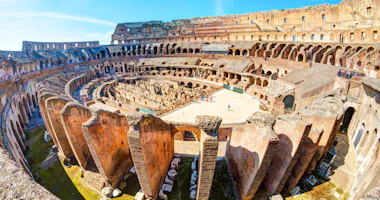
Colosseum, Roman Forum
and Palatine Hill: Skip lineColosseum, Roman Forum
and Palatine Hill: Skip lineSkip the long lines at the Colosseum with this priority-entrance ticket. This ticket will let you bypass the crowds. And after exploring the Colosseum you can head to the Roman Forum + Palatine Hill and enter directly
read more... -

Vatican Museums & Sistine Chapel: Skip The Line
Vatican Museums & Sistine Chapel: Skip The Line
Save time and stress with priority entrance and skip the line. Admire countless masterpieces by Michelangelo, Raphael, Caravaggio, Tiziano, and the Sistine Chapel.
read more... -

Borghese Gallery
Fast TrackBorghese Gallery
Fast TrackGalleria Borghese is located in Villa Borghese park. Admire the architecture and furnishings of this beautiful villa, home to a rich collection of Renaissance art, sculptures, and paintings. Get tickets weeks in advance due to limited capacity.
read more... -

St. Peter's Basilica:
Express Guided TourSt. Peter's Basilica:
Express Guided TourExperience the St. Peter’s Basilica with this express guided tour that includes reserved entrance, allowing you to bypass long lines and make the most of your time.
read more...
Botanical Garden
Botanical Garden of Rome
Current visitor information
Checked
Plan your visit
The Passeggiata del Gianicolo entrance, normally for online-ticket holders only, is temporarily unavailable according to the 29 September 2026 notice. No reopening date is given: use Largo Cristina di Svezia 23A.
There is a fairytale place hidden in the heart of the Eternal City. Walking through the streets and alleys of
the city area right of the river Tiber, you do not expect to find this large and lush
green oasis. We are just a stroll away from the Trastevere district, in one of the most
beautiful areas of Rome, between the Gianicolo hill and Villa Farnesina. During summer, this is the perfect place to escape, enjoy some shade from the scorching sun, and
explore the park avenues surrounded by greenery. Today we want to take you for a visit to the Botanical Garden of Rome.
This large park is often left
out of the main tourist routes. We do not know why, but, in a way, its magic is also due
to the relatively low presence of visitors. Especially those traveling with the whole
family can enjoy the magnificence and charm of native and exotic plants and flowers right in the middle of the
Capital, while children run and play through the intricate paths of the gardens.

What to see
The park covers an area of about 12 hectares and also includes 2.000 square meters of
greenhouses. There are thousands of species featured, including almost 400 specimens of trees and secular plants: in
Rome, also the natural landscapes tell us something about the story of the city!
The best way to visit
the park is to follow a pretty much circular path, which will take you to almost every
the place of interest. The park paths wind through palm trees, roses, ferns and bamboo, to reach the wonder of the
Japanese Garden with its fascinating pond. Plus, there are
sequoias, tropical plants and a huge variety of native species. Among the greenhouses that can be visited, we suggest you to head
to the one called "Corsini", which hosts many varieties of succulent plants and cactus, and the Greenhouse of Orchids, with hundreds of species, some of which are very rare.


Along the way, the avenues widen into squares or clearings, for a well-deserved rest on a bench, maybe after you had a long walk around town, to discover the adjacent district of Trastevere or the belvedere terrace on the near Gianicolo hill. One of the most striking features here is tranquility and silence, interrupted only by the birds singing while finding shelter among the leafy branches of the trees.
Depending on the season of the year, the colors and appearance of the park change dramatically, offering to the visitors an ever-new experience of the wonders of nature. In April, the Japanese Garden becomes a jubilation of colors, thanks to the blooming of the
many cherry trees. A little later, in May, it’s the turn of the roses: you can admire about 60 different species!
During summer, there are still many flowers around, belonging to
the so-called "late-blooming” plants, whilst in September and October, the leaves of the trees are enriched with all the warm autumn shades and colors.
In addition to the
numerous species of plants, the park also features some interesting works of art, such as
the Triton Fountain and the Fountain of the 11 Spouts, built on a staircase that belonged
to the residence of Queen Christina of Sweden. Moreover, here you can also find busts and statues dating back to
the Roman era and a beautiful lookout to the monuments and the characteristic roofs of Rome.
Adjacent to the park, you can also visit
the Butterfly House (Butterfly Eden). To enter this, though, you have to pay an
additional ticket.


Brief history: from the Pope’s medicinal herbs to the university
The Botanical Garden stands on part of the land that once belonged to the baths of Emperor Septimius Severus. The small section that is
located almost at the end of the visitor route, on the right, is, historically speaking,
the first nucleus of this green oasis. To the present day, it has preserved its original name: the Giardino dei
Semplici (the Garden of the Simple), which is referred to the medicinal herbs, formerly called “simple herbs”. It
was built by Pope Boniface VIII during the thirteenth century, to cultivate medicinal plants.
From this first nucleus,
the park grew over the centuries. In the Fifteenth century, important restoration works were carried out and, thanks
to the water of the ancient aqueduct of Trajan, it was possible to create one of the largest botanical gardens in Europe. In 1600, pope Alexander VII decided that the botanical garden had to be managed by the University, formally lifting it from the control of the Vatican. In this period, thanks to the travels and the
discoveries of new territories, exotic and unknown plants arrived to Rome: opening new possibilities and fields of studies for botany scholars
.
Until the second half of 1800, the park was not open to the public and was only accessible to professors and students. With the unification of Italy, the state acquired the entire Corsini estate, which included the palace (now home to the National Gallery of Ancient Art) and the park.


What to see near the botanical garden
The Botanical Garden is adjacent to many attractions, including the just mentioned
Corsini Palace. Built in the fifteenth century, it was completely renovated in 1700 thanks to the cardinal Neri Maria Corsini. The works were directed by
the architect Ferdinando Fuga, who built one of the most elegant mansions in the capital.
Inside the splendid halls, the palace houses a rich collection of unique pieces by artists
such as Caravaggio, Beato Angelico and Rubens. In addition, from the palace you can admire a beautiful view of the gardens.
Among the other places within walking distance of the Botanical Garden, you can visit Villa Farnesina (with
an incredible collection of frescoes by Raffaello Sanzio!), take a romantic walk up to the Gianicolo hill terrace, and visit the district of Trastevere
.

How to arrive, tickets and activities
The address is Largo Cristina di Svezia 24, in the Trastevere district.
To get to the Botanical
Garden by public transport you have the following options:
From Rome North or Rome South, we advise you to get off at the
Ponte Sisto bus stop with buses 23 or 280. Then, you will have to walk for about 450
meters to your destination. Otherwise, from the city center, you can take the tramway n.8 to the Piazza Gioacchino Belli stop and then walk for about 850 meters.
The gardens are open every day, including Sundays.
During winter time (from November to March) opening hours are 9
.00 to 17.30, while during summer time (from April to October) hours are
9.00 to 18.30.
The cost of the ticket is a nice surprise: just € 4.00. It used to be more expensive, but the reduced rate, normally reserved for children and over 65, has been extended to all
visitors.
The entrance for the disabled and their companions is free of charge.
On request, and for
a surcharge, it is possible to book a guided tour, available for groups as well. Some
Sundays of the year, guided tours are free, but reservation has to be made in advance and tickets are subject to availability.
As these gardens are also home the Department of Botanical Studies of the La Sapienza University of Rome, there is an active collaboration with the campus, with a rich calendar of events and numerous initiatives, such as special visits and tours, seminars and educational activities.


Accessibility and other useful information
The Botanical Garden is wheelchair accessible, with a dedicated path. However, some particular places, due to gradients or other
architectural barriers, may not be easily accessible by wheelchair.
A project still in progress has
provided the area of the “Garden of the Senses” with Braille tags for the blind. Dogs are not allowed in, except guide dogs for the blind
.
Inside the gardens there are no bars or shops. However, you can buy some drinks and snacks from the vending
machines that are located inside the premises. In any case, as it happens
everywhere in the center of Rome, here you’ll find the small public fountains
with drinkable fresh water to refill your bottles. Especially during summer and early
autumn, it is advisable to bring a bottle of mosquito repellent.

FAQ
-
Where is the Botanical Garden in Rome?
The gardens are located in the city center, between the Trastevere district, the Gianicolo Hill and Villa Farnesina. The area lies on the right bank of the Tiber river.
-
What can I see in the Botanical Garden in Rome?
In the large park area you can see thousands of species plants and flowers, included hundreds of secular trees. There are greenhouses with rare orchids and cactus, a Japanese Garden, plus ancient fountains and statues.
-
Is the Botanical Garden in Rome suitable for kids?
Yes, the Botanical Garden is a perfect place for kids. They can run in the park and its intricate paths, exploring trees, plants and flowers.
-
Is the Botanical Garden in Rome wheelchair accessible?
Yes, the Botanical Garden is wheelchair accessible. However, due to some architectural barriers, some areas may not be easily accessible.
-
How do I get to the Botanical Garden in Rome?
You can arrive at the Botanical Garden with the buses 23 or 280 (Ponte Sisto stop). Otherwise, from Trastevere, you can take the tramway n. 8 in Piazza Gioacchino Belli square.
-
When is the Botanical Garden in Rome open?
The gardens are open every day of the week, including Sundays. Opening hours are from 9 am to 5.30 pm (winter) or 9 am to 6.30 pm (summer).
-
How much does it cost the ticket to the Botanical Garden?
There is a flat fee ticket of € 4.00 that applies to all visitors. Disabled people and their carers have free access.
You might also like

Aqueduct Park
The Aqueduct Park is a large green park in the South East area of Rome. Here you can see the remains of a number of acqueducts built during the Roman Empire and beyond. Entrance to the park is free.
Read more...
Trevi District
Trevi District's name was derived from the Latin word trivium which refers to its three main roads. It is where Trevi Fountain is located.
Read more...
Baths of Caracalla
The Baths of Caracalla is the second largest baths in Rome. It was a large complex with an area of 120,000 square meters and it can accommodate 1600 guests.
Read more...
Villa Borghese
Villa Borghese is a great landscape garden in Rome, containing a number of buildings, museums, and attractions. It is the second largest public park in Rome
Read more...