Tours
More excursions & tours-

Rome Tourist Card
Rome Tourist Card
Snap up the Rome Tourist Card and you'll get everything you need to explore Rome's top highlights including Colosseum, Palatine Hill, Roman Forum and Hop on/off bus. You can even choose the order you see things in.
read more... -
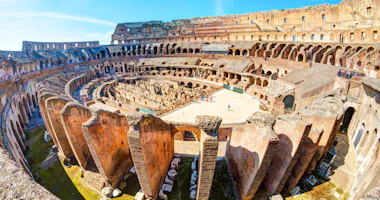
Colosseum, Roman Forum
and Palatine Hill: Skip lineColosseum, Roman Forum
and Palatine Hill: Skip lineSkip the long lines at the Colosseum with this priority-entrance ticket. This ticket will let you bypass the crowds. And after exploring the Colosseum you can head to the Roman Forum + Palatine Hill and enter directly
read more... -

Vatican Museums & Sistine Chapel: Skip The Line
Vatican Museums & Sistine Chapel: Skip The Line
Save time and stress with priority entrance and skip the line. Admire countless masterpieces by Michelangelo, Raphael, Caravaggio, Tiziano, and the Sistine Chapel.
read more... -

Borghese Gallery
Fast TrackBorghese Gallery
Fast TrackGalleria Borghese is located in Villa Borghese park. Admire the architecture and furnishings of this beautiful villa, home to a rich collection of Renaissance art, sculptures, and paintings. Get tickets weeks in advance due to limited capacity.
read more... -

St. Peter's Basilica:
Express Guided TourSt. Peter's Basilica:
Express Guided TourExperience the St. Peter’s Basilica with this express guided tour that includes reserved entrance, allowing you to bypass long lines and make the most of your time.
read more...
Mouth Truth
La Bocca della Verità, known in English as the Mouth of Truth, is one of the most interesting sculptures in Rome. It is a huge Pavonazzo marble mask weighing more than 1,300 kg (2,800 pounds). It’s shaped as a disc, with carvings of a male face with wide open mouth, nostrils and eyes. You can find the Mouth of Truth at the ancient cattle market in Piazza della Bocca della Verità, specifically at the left side wall of the portico of the Santa Maria in Cosmedin church.
.
While it’s one of the best-known sculptures in Rome, the Mouth of Truth is surrounded by question marks. Little is known about it, other than the fact that it’s a couple of thousand years old. Myths and legends surround this massive piece of carved marble, which may very well be the reason behind its enduring appeal.


The Mouth of Truth Legend
In the Middle Ages, the Mouth of Truth myth was born: it was said that liars who placed their hand inside the sculpture would immediately lose it. Supposedly, Medieval Romans saw the sculpture as a lie detector for those who committed acts like adultery and perjury. Piazza della Bocca della Verità was often a stopping point for trials of petty criminals, and travelers talked of a mythical practice that created a legend.
Those accused of petty crimes were asked to take an oath to their honesty at the piazza. They would then go through a great trial: answer the executioner’s questions with their hand inside the Mouth of Truth. If their words were true, they were sure to remain unharmed; if they lied, their hand would be bitten off. This terrifying ordeal served as a way to make people more honest, out of fear for consequences.
Of course, there was a catch, and there was less magic involved than the authorities would have people believe. It is said that on the other side of the sculpture stood a second executioner with a very sharp sword. If the executioner thought the accused was being untruthful, off with his hand it was.
As so many other stories regarding this sculpture, there’s no proof that any of the above ever happened. Yet the tale lives on, hundreds of years later.
This medieval myth became a well-known part of the Roman culture and is still a popular tall tale. To this day, Roman parents will tell the Mouth of Truth legend to their children: if you lie, young one, you’ll get your hand bitten off. Mammas will often tell kids they’ll take them to this ancient magical sculpture to test their honesty!
Roman Holiday Film
“The legend is that if you're given to lying, you put your hand in there, it'll be bitten off,” Joe Bradley tells a fascinated Princess Anya in Roman Holiday.
In the rest of the world, the Mouth of Truth myth became well-known thanks to the 1953 film Roman Holiday. The movie was Audrey Hepburn’s breakout role, playing a princess who escapes her royal duties. She finds a reporter, Gregory Peck, who shows her around Rome in a Vespa. At some point, they visit the Mouth of Truth and Peck’s character tells the legend of the Bocca della Verità, then pretending he got his hand bitten off.· Nearly 60 years later, this Roman landmark remains heavily associated with the film, and people will often visit to reenact the famous scene.
History
Even today, historians are still uncertain about where the disc came from and even its original purpose. The general consensus seems to be that it depicts a Roman god of ancient times, but there are plenty of theories as to which one. The most popular theory says it depicts the face of Oceanus, a titan god of the sea.·
Another theory about the origins of the Bocca della Verità states that it was used by merchants as a downpipe to drain the blood of the cattle slaughtered as a sacrifice to Hercules. Meanwhile, others say the marble mask depict the head of Faunus, the Roman horned god of the forests. Lastly, a few historians believe that it was created to represent the god of the tiber river.
There is, however, no evidence that shows any of these claims was actually factual. As it is, the mystery remains and we may never know which deity is represented in the Mouth of Truth.
As for its location, some historians believe that the disc was actually a drain cover or manhole cover used in the nearby Temple of Hercules Victor. This ancient temple was designed with a round open space in the middle of the roof, which meant that water came in whenever it rained. As such, the mouth served as a fountain.
What we do know is that the marble mask was taken out from whatever its location was and placed on the Piazza della Bocca della Verità in the 13th century. A long time later, in 1632,· it was moved to its current location, on the wall of Santa Maria in Cosmedin.
If we trace the believed placement over the centuries, it has never left the complex. From the Temple of Hercules Victor (or Hercules Olivarius) to the Mouth of Truth Square to Santa Maria in Cosmedin, this imposing sculpture has always remained in the same area.

Santa Maria in Cosmedin
If one of the reasons you’re visiting Rome is its churches, we definitely recommend seeing the Basilica of Saint Mary in Cosmedin. This minor basilica was first built in the 6th century, with additions in the 8th and 11th centuries. It was a church for the Greek community in Rome, from which it received its name Cosmedin, from the Greek word for “ornate.”
The beautiful mosaic floors and the medieval choir enclosure are some of its loveliest highlights. It’s also said to be the final resting place of the head of Saint Valentine, patron saint of love.
The church’s 8th-century crypt, located below the choir, was built to store relics from the Roman catacombs. It’s like a small basilica with niches lined up in their side walls, and relics stored in marble.


Essential Mouth of Truth info
Address. Piazza della Bocca della Verità 18.
Metro. The nearest metro station is Circo Massimo, on Line B (blue), which is about 300 meters away.
Bus. To reach the area by bus, you can take the lines 95, 160, 170, 44, 716 or 781 and stop at the Piazza della Bocca della Verità.
Schedules. Winter, from 9:30 am to 5pm (last entry is at 4:50 pm); Summer, from 9:30 am to 6 pm (last entry is at 5:50 pm ).
Tickets. It’s a €2 entrance to the church, which will allow you to get up close to the sculpture. However, the Mouth of Truth is visible from the outside of Santa Maria in Cosmedin, and you can take pictures of it for free if you don’t mind being a little further away.

FAQ
-
How old is the Mouth of Truth
In the 17th century, the Mouth of Truth was placed in the Basilica of Santa Maria in Cosmedin. The disc itself is much older. It is not known exactly how old the Mouth of Truth is.
-
What is the Mouth of Truth?
The Mouth of Truth is a stone disc with a face with an open mouth. In the Middle Ages, this was thought to be a lie detector. Presumably the disc is actually a manhole cover with the face of a river God
-
What is the legend behind the Mouth of Truth?
It used to be thought that the Mouth of Truth is a lie detector. You put your hand in the mouth. If you have lied, your hand is bitten off by mouth. If you tell the truth, nothing will happen
-
Where can I find the Mouth of Truth?
The Mouth of Truth is in the side portal of the Basilica Santa Maria in Cosmedin
-
How did the Mouth of Truth get his name?
The Mouth of Truth takes its name from the legend. In the Middle Ages, this disk was seen as a lie detector
You might also like

Crypts and Catacombs Rome Tour
Explore Rome’s deepest and darkest through the Crypts and Catacombs Rome Tour. Visit the underground passages where the first Christians were buried.
Read more...
Churches in Rome
Although the Vatican is a separate and independent country today, Rome still remains popular for its many churches spread throughout the city.
Read more...
Quick overview hotels Rome
There are many hotels in and near the Historic Center of Rome like Colosseum, St Peter’s Basilica, Raphael’s tomb at the Pantheon and Galleria Borghese.
Read more...
Villa Borghese
Villa Borghese is a great landscape garden in Rome, containing a number of buildings, museums, and attractions. It is the second largest public park in Rome
Read more...