Tours
More excursions & tours-

Rome Tourist Card
Rome Tourist Card
Snap up the Rome Tourist Card and you'll get everything you need to explore Rome's top highlights including Colosseum, Palatine Hill, Roman Forum and Hop on/off bus. You can even choose the order you see things in.
read more... -
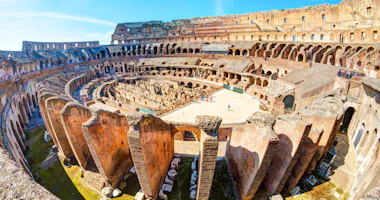
Colosseum, Roman Forum
and Palatine Hill: Skip lineColosseum, Roman Forum
and Palatine Hill: Skip lineSkip the long lines at the Colosseum with this priority-entrance ticket. This ticket will let you bypass the crowds. And after exploring the Colosseum you can head to the Roman Forum + Palatine Hill and enter directly
read more... -

Vatican Museums & Sistine Chapel: Skip The Line
Vatican Museums & Sistine Chapel: Skip The Line
Save time and stress with priority entrance and skip the line. Admire countless masterpieces by Michelangelo, Raphael, Caravaggio, Tiziano, and the Sistine Chapel.
read more... -

Borghese Gallery
Fast TrackBorghese Gallery
Fast TrackGalleria Borghese is located in Villa Borghese park. Admire the architecture and furnishings of this beautiful villa, home to a rich collection of Renaissance art, sculptures, and paintings. Get tickets weeks in advance due to limited capacity.
read more... -

St. Peter's Basilica:
Express Guided TourSt. Peter's Basilica:
Express Guided TourExperience the St. Peter’s Basilica with this express guided tour that includes reserved entrance, allowing you to bypass long lines and make the most of your time.
read more...
Circus Maximus
Show business was a very serious thing in Rome. The citizens loved to be entertained and the Circus Maximus was designed as a fully equipped area, featuring an incredibly large racecourse, complete with shops, street food and, of course, bookmakers.
The Circus Maximus was the largest venue for shows, performances and races of the ancient era. Actually, with its 600 meters in length, 140 meters in width and the seating capacity of about 300,000 spectators, it’s considered the biggest structure built for entertainment purposes in the entire history of mankind. Just to give you a basis for comparison, the May Day Stadium (in North Korea), the largest “modern” structure of our era, can accommodate “only” 150,000 people.

History of the Site
The original circus was built back in the sixth century BC, between the Palatine and the Aventine Hills when Rome was still a kingdom and not an empire, by will of the king Tarquinio Prisco. The place was originally mainly used as a racecourse for chariot races.
In 50 BC, Julius Caesar expanded the circus, which became a brick structure featuring the central spine, a long central platform decorated with statues and shrines. Later, Augustus added the “pulvinar” to the stage, which was the Imperial Box to watch games and matches, basically the forebear of the modern V.I.P. Lounge. He also added an obelisk to celebrate his victories in Egypt.
In 81 AD, the Senate wanted to build a triumphal arch, in honor of the Emperor Titus. The arch was on the short eastern side and had three large gilded bronze cones grouped on a high semicircular base. This arch served as the entrance to the Circus Maximus.
Over the years, three different fires damaged the structure badly. It was the Emperor Trajan, who finally restored it to its original splendor. In the fourth century, a second obelisk was brought from Egypt, and was placed on the spine restoring it to it's orginal appearance. The stands were three storeys high, made of stone and lined with marble.


The Roman Games (Ludi Romani)
The Romans loved gladiatorial games and shows featuring four-horse chariot races called “quadrighe”. The participants were usually slaves organized in “teams” and the prize up for grabs was their freedom. The supporters of the most successful riders gathered in large groups in the stands, cheering on their favorite riders with the same enthusiasm you can witness during a contemporary football match.
Other shows included wild animals’ hunting parties, theater performances, combats between gladiators, and very unusual events, such as a deadly clash between a group of gladiators and twenty elephants, organized by Pompeo, a prominent political leader during the first century BC.
Around the circus there were grocery stores, taverns, laundries, but also warehouses, brothels, bureaux de change and betting shops. Some remains of these premises are still visible today.

The Site Today: The Terrace, The Tower, the Augmented Reality Tours
Today, the site doesn’t show much of its original splendor. The grass-covered racing track and the outline of the central barrier are the only elements left from the original floor plan. Some remaining stands and the two Egyptian obelisks that once decorated the stadium were moved. One was placed in the Piazza del Popolo and the second was moved next to the Basilica of St. John in Lateran.
At the southern end, there is a panoramic terrace and a medieval tower, called Torre della Moletta, which has been restored and it’s now accessible up to the second floor, where you’ll be able to admire a nice view.
But, thanks to technology, you will be able to enjoy a unique visit. You can book an exciting augmented reality tour, called the Circo Maximo Experience. You will get special visors to walk around the site and admire its original beauty and monumental splendor. Below, you can watch a short presentation of the tour. The Circo Maximo Experience is a project of the Superintendence of Cultural Heritage of Rome (Sovrintendenza Capitolina ai Beni Culturali).·
The Circus Maximus is often used as a location for big events or concerts featuring international stars, such as, Bruce Springsteen or the Rolling Stones, among others. During the day, Romans come here to jog or simply relax in the sun.
The Surroundings
At the side of the circus, you can see the ruins of the thermal complex built by the Emperor Septimius Severus. And, if you take a stroll toward the Aventine Hills there are a couple of very special places you really don’t want to miss when visiting the city.
One is the Orange Garden (Giardino degli Aranci), a park right at the top of the hill, with a large terrace where you can enjoy a stunning view of the city. Just outside the park, you’ll find the splendid Basilica of Santa Sabina, a Paleo-Christian church which dates back to the sixth century AD, which has been restored in various stages during the years and features incredible works of art. Below the church, it’s possible to visit the remains of the ancient structure and mosaics of the era of the Roman Empire.
Continue on Santa Sabina Street (Via di Santa Sabina) and here, where the road widens, you’ll find one of the most famous sites for spotting St . Peters from… a keyhole! When the road widens, at your right, there’s the marble gate of the of the Priory of the Knights of Malta, the main residence of the order.
The monumental entrance features a door. Looking through the keyhole, you’ll discover that it points right at the dome of St. Peter. Is that a coincidence? Apparently not, as the architect Piranesi, who restructured the entrance in 1765, was commissioned this work by a very influential cardinal.

FAQ
-
What is the Circus Maximus?
The Circus Maximus was a venue for shows, performances and races in ancient Rome. With its seating capacity of about 300,000 spectators, it’s considered the biggest structure built for entertainment purposes in the entire history of mankind.
-
Where is the Circus Maximus?
The Circus Maximus is located in the valley between the Palatine and Aventine hills in the 6th Century BC.
-
How can I reach the Circus Maximus?
It’s very easy to get the the Circus Maximus. Just take the Metro (Line B) until the stop called Circo Massimo.
-
Is the Circus Maximus free to access?
Yes, the area it’s free to access. But you can also book, for a fee, an Augmented Reality Tour called Circo Maximo Experience.
-
Is the Colosseum near the Circus Maximus?
Yes, the Colosseum is about 1 km away from the Circus Maximus
You might also like

Monuments Rome
Rome has proven itself to be a strong city, judging by its monuments that have withstood the test of time. Not all monuments in Rome are that lucky
Read more...
Rome map Sightseeing
Are you planning your sightseeing trip in Rome. And see besides the common attraction like Colosseum, Pantheon and the Vatican what else Rome has to offer?
Read more...
Quick overview hotels Rome
There are many hotels in and near the Historic Center of Rome like Colosseum, St Peter’s Basilica, Raphael’s tomb at the Pantheon and Galleria Borghese.
Read more...
The Colosseum
The Colosseum or is the most famous and largest monument of the Roman Empire. Originally a place of entertainment, especially known for it's gladiator battles, it's Rome's most famous landmark and one of the seven world wonders.
Read more...