Tours
More excursions & tours-

Rome Tourist Card
Rome Tourist Card
Snap up the Rome Tourist Card and you'll get everything you need to explore Rome's top highlights including Colosseum, Palatine Hill, Roman Forum and Hop on/off bus. You can even choose the order you see things in.
read more... -
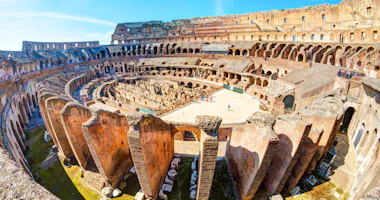
Colosseum, Roman Forum
and Palatine Hill: Skip lineColosseum, Roman Forum
and Palatine Hill: Skip lineSkip the long lines at the Colosseum with this priority-entrance ticket. This ticket will let you bypass the crowds. And after exploring the Colosseum you can head to the Roman Forum + Palatine Hill and enter directly
read more... -

Vatican Museums & Sistine Chapel: Skip The Line
Vatican Museums & Sistine Chapel: Skip The Line
Save time and stress with priority entrance and skip the line. Admire countless masterpieces by Michelangelo, Raphael, Caravaggio, Tiziano, and the Sistine Chapel.
read more... -

Borghese Gallery
Fast TrackBorghese Gallery
Fast TrackGalleria Borghese is located in Villa Borghese park. Admire the architecture and furnishings of this beautiful villa, home to a rich collection of Renaissance art, sculptures, and paintings. Get tickets weeks in advance due to limited capacity.
read more... -

St. Peter's Basilica:
Express Guided TourSt. Peter's Basilica:
Express Guided TourExperience the St. Peter’s Basilica with this express guided tour that includes reserved entrance, allowing you to bypass long lines and make the most of your time.
read more...
Piazza Venezia
Piazza Venezia or Venice Square is a square in Rome located where four major roads meet. These roads are the Via del Corso, Via del Plebiscito, Via di Teatre Marcello and Via dei Fori Imperiali. Through these four roads, Piazza Venezia is also known for its chaotic traffic.
Piazza Venezia is located at the foot of the Capitoline Hill. It owes its name to Palazzo Venezia.
Palazzo Venezia building was commissioned by Pietro Barbo, who later became Pope Paul II. The building was designed by the architect Francesco del Borgo. He started its construction in 1455.
Then Palazzo Venezia has served as Embassy of the Republic of Venice, and was used by the Austrian ambassador. The Italian government took over the palace during the First World War. Today Palazzo Venezia is a museum of Medieval and Renaissance art, Museo di Palazzo.
·

This monument was erected to the first King of Italy, Victor Emmanuel II. It is also called Altare della Patria (Altar of the fatherland.)
The monument was designed by Giuseppe Sacconi and was built between 1895 and 1911. Inside the museum there is a collection of works regarding the unification of Italy.
Palazzo Bonaparte was built in 1666 for the family d’Aste. The building was occupied by several families. A well-known resident was the mother of Napoleon Bonaparte, Maria Laetitia Ramolino. Her half brother arranged this house for her when she was expelled from France. Palazzo Bonaparte was named after her.
Basilica San Marco is one of the oldest basilicas of Rome. It was built in 336 AD. There have been various remodeling works in Basilica San Marco and the largest was in the ninth century. In 1451 the basilica was part of Palazzo Venezia
This basilica is actually located on the San Marco square. But since this little square is surrounded on all sides by Piazza Venezia, you can also see it as a part of this square.
Madame Lucrezia is a bust which stands at the Basilica San Marco. It was placed there by Cardinal Lorenzo Cybo in 1500. At that time he was the Cardinal of San Marco.
The sculpture represents the Egyptian goddess Isis and is probably derived from a Isis temple.
Madame Lucrezia is also known as one of the most striking images. At the time when the popes were in power in Rome, people started to write and stick several slogans on the image to express their dissatisfaction.

You might also like

Capitoline Hill
The Capitoline Hill is the smallest among the seven hills of Rome. You can find it near the Roman Forum. The current appearance of the Capitoline Hill is primarily determined by Michelangelo’s Piazza del Campidoglio, including the construction of the square as well as the renovation of the several existing buildings.
Read more...
Top Rated Hotels near Colosseum Roman Forum
There are many hotels and holiday residences that you can find at Rome’s center, which are just a quick stroll away from the main spots in Rome.
Read more...
Tivoli
Tivoli is an ancient Italian town in Lazio that is around 30 kilometers away east of Rome. It has a total land area of 68 sq km and a population of 53,195.
Read more...
Traveling to Rome with Kids
The best spots and entertainment locations, not just necessarily cultural experiences, but places that your kids will definitely have a blast visiting.
Read more...