Tours
More excursions & tours-

Rome Tourist Card
Rome Tourist Card
Snap up the Rome Tourist Card and you'll get everything you need to explore Rome's top highlights including Colosseum, Palatine Hill, Roman Forum and Hop on/off bus. You can even choose the order you see things in.
read more... -
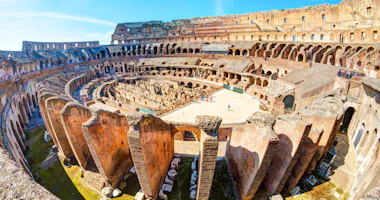
Colosseum, Roman Forum
and Palatine Hill: Skip lineColosseum, Roman Forum
and Palatine Hill: Skip lineSkip the long lines at the Colosseum with this priority-entrance ticket. This ticket will let you bypass the crowds. And after exploring the Colosseum you can head to the Roman Forum + Palatine Hill and enter directly
read more... -

Vatican Museums & Sistine Chapel: Skip The Line
Vatican Museums & Sistine Chapel: Skip The Line
Save time and stress with priority entrance and skip the line. Admire countless masterpieces by Michelangelo, Raphael, Caravaggio, Tiziano, and the Sistine Chapel.
read more... -

Borghese Gallery
Fast TrackBorghese Gallery
Fast TrackGalleria Borghese is located in Villa Borghese park. Admire the architecture and furnishings of this beautiful villa, home to a rich collection of Renaissance art, sculptures, and paintings. Get tickets weeks in advance due to limited capacity.
read more... -

St. Peter's Basilica:
Express Guided TourSt. Peter's Basilica:
Express Guided TourExperience the St. Peter’s Basilica with this express guided tour that includes reserved entrance, allowing you to bypass long lines and make the most of your time.
read more...
EUR district
EUR is a modern and rather ‘new’ district in the South of Rome. This neighborhood was originally designed to host the World Expo Fair of 1942, hence the name (Universal Expo in Rome - E.U.R.). Due to the beginning of World War II, the expo didn’t take place and, among the buildings that were designed for the event (mainly convention centers), the district evolved in a busy business and residential area.·
Among the EUR landmarks, here you will find a large park with an artificial lake, a well-known amusement park and some serious nightlife. Since 2018, in the month of April, the district has regularly hosted the Formula E World Championship, featuring one of the longest city circuits of this tournament. The area is nice during the day, but at night has a very special character, because all the main buildings feature impressive lighting.


Ancient Glory in Modern Times
The whole EUR original plan was designed by the architect Marcello Piacentini, who gave form to the ideas of the Mussolini regime, and the will to bring the classical and monumental splendor of the Roman Empire back into modern life. In contrast to the Renaissance and Baroque style of many of the city’s main landmarks, this area features wide streets and buildings which reflect the rationalism and simple lines of the fascist architecture of the time, which aimed at celebrating the greatness of the Italian people and its culture. The result of this approach to the district plan is tall and angular buildings, featuring some elements common during the emperor’s era, such as overlapping arches, white marble and travertine.·
The area is situated about three kilometers from the city center and it was supposed to become the symbol of a renovated city and the new entrance to Rome. The project and construction began in the ‘30s, and, because of the war, was only completed in 1960, just before the Rome Olympic Games. Many of the buildings included in the original design were never constructed. In fact, the whole project was re-defined, including sports centers, services, convention centers, recreational areas and residential buildings.

What To See
The Palace of Italian Civilization (The Square Colosseum)
This building is one of the symbols of EUR. Also called the square Colosseum, this six-storey palace was designed by Marcello Piacentini and built in the ‘30s. The structure is in concrete, covered with travertine marble, and it features 54 arches on each facade. Recently, it has been used as an exhibition center and it has been leased, up to 2028, to the Italian fashion house Fendi.
The Lake’s Central Park (also called Laghetto)
This artificial park is a perfect place to relax on the grass while the kids are on the site’s playground. You can also rent a pedal or an electric boat for a nice ride on the calm waters of the lake. The best time to come here is definitely spring, when the many Japanese cherry trees that are planted here are in full bloom. If you fancy something to eat, the lake is surrounded by several gelaterias and cafeterias.
The Waterfall Gardens
Surrounded by well-groomed hedges and flowers, the waterfalls have not only recently been renovated, but have finally opened to the public after more than 50 years, in 2017. In fact, this area, which belongs to the larger Lake Park, was officially inaugurated during the Olympic Games, but, since then, has been closed for many years. It goes without saying that, if you are looking for a nice souvenir picture, this is the perfect scenery.

The Marconi Obelisk
This 45 meter high obelisk has been designed by the artist Arturo Dazzi, and it’s part of the original area plan of the ‘30s, even if it was only completed in 1959. It is located on the main road in the district, Via Cristoforo Colombo, and it’s visible from the park. The monument is dedicated to Guglielmo Marconi, the inventor of the radio and the 1909 winner of the Nobel Prize in Physics. The obelisk is in concrete, covered with Carrara marble slates featuring high reliefs.
It has to be noted that many EUR streets are named after the main Italian explorers and inventors, while others celebrate the human progress, through names such as Technology, Agriculture, Humanism, Industry and Art.
S.S. Peter and Paul’s Basilica
The building of the church started in 1939, but was abruptly halted by the war, when it was bombed. During the conflict, in 1943, the site was unfortunately even a scene of clashes between the Italian and German army. The church was finally opened in 1955, and it features a Greek cross floor plan and a large dome, which measures 32 meters in diameter, one of the largest and tallest in Rome.
Rome’s Convention Centre (Fuksas 'Cloud')
This large modern complex was completed in 2014. If you love contemporary architecture you will enjoy this large glass building which contains a suspended 'cloud' which hosts an auditorium for 1,800 people. The project was designed by the renowned architect Massimiliano Fuksas and it’s an interesting piece of conceptual art, where technology has been extensively used to create a unique site. It is an expo center, but also the symbol of a new and environmentally friendly architecture. The complex features convention halls and a large hotel. In 2012 it was awarded the Best Building Site Prize from the Royal Institute of British Architects.
The Museums
In this district there are several interesting museums:
Museo dell’Alto Medioevo – The Early Middle Ages Museum
Museo delle Arti e Tradizioni popolari – The Museum of Arts and Popular Traditions
Museo Preistorico Etnografico L. Pigorini – The Pigorini Prehistoric Ethnographic Museum
Museo della Civiltà Romana – The Museum of Roman Civilization
The Sports Palace
Palazzo dello Sport (also called PALAEUR) was contructed for the 1960 Olympic Games. The building is located on the top of the second Southern hill. This sports hall can accommodate up to 20,000 visitors. In addition to sporting events, Palazzo dello Sport is also used for concerts, parties and trade Union congresses.
Shopping and Entertainment
The Shopping Centre
Shopping center Euroma 2 is an atmospheric, slightly kitschy and richly decorated indoor shopping center. There are many shops, for every budget, with a particular focus on apparel and food. Kids will love the Lego shop or dining with a pizza at Alice. As is Roman tradition, the pizza here is cut in rectangular slices ('pizza al taglio'). You can choose different toppings for every piece, so the result is a plateful of delicious pizza varieties. If you are a·fan of technology, you can pay a visit to the Apple store. But, without a doubt, fashion here rules, and there are many boutiques and signature shops to satisfy all your shopping needs. Also, there is a large supermarket. The shopping mall Euroma 2 is in Viale dell’Oceano Pacifico 83.


The Fourteenth Foor (Il Quattordicesimo Piano) Restaurant @ il Fungo
Il Fungo (the 'mushroom') is a water reservoir 53 m tall, which was built for the Olympic Games, as it has to ensure drinkable water supply to the area. At the top, there is a classy restaurant called 'The Fourteenth Floor', where you can enjoy a beautiful view of the city.
EurPark
Located in Piazza Pakistan Square, this is an outdoor theme park, suitable for both adults and children, and divided into two areas. There is the adventure park, featuring several climbing courses set out in the trees where you can also practice archery. In the area called 'Energy' there are several sporting activities, such as skateboarding, a mountain bike trail and a fun human table soccer. The park also organizes workshops for kids.


EUR’s Nightlife
EUR is home to some of the most well-known discos in Rome, such as the Room36 and Spazio Novecento and Project Roma, and some posh restaurants and wine bars (Pier Eur, Tiki Bar). You can find suggestions for your night out in Rome by visiting our page about nightlife in Rome.·
Luneur Park (Amusement Park)
Recently renovated in 2016, the Luneur is the oldest amusement park in Italy, as it originally opened in 1953. The park has attractions for kids of every age and it features a famous multi-colored Ferris wheel. It is possible to purchase a ticket for each attraction or a daily pass . The park hosts regular events. Plus, there are several themed restaurants and cafeterias, including a pizzeria and the house of ice cream.·
How to Get to EUR
Reaching EUR is very easy, even if this area is not close to the historical center, because it is well connected via the subway. You just have to take the Metro Line B and get off at EUR Palasport. It’s a 20 minute ride from the Termini Station.·

You might also like

Ostia Antica
Ostia Antica is the oldest archeological site that has become the main trading harbor of ancient Rome. Ostia Antica was founded by King Ancus Martius in 620 BC.
Read more...
Baths of Caracalla
The Baths of Caracalla is the second largest baths in Rome. It was a large complex with an area of 120,000 square meters and it can accommodate 1600 guests.
Read more...
Water Parks Rome
Visiting the water-parks would add a different thrill in your Rome trip. The two major water parks in Rome are the Aquafelix and the Hydromania.
Read more...
Rome Tours
Touring around Rome by yourself with your map at hand and just wandering around every historic corner of the city is such a pleasing and exciting experience.
Read more...