Tours
More excursions & tours-

Rome Tourist Card
Rome Tourist Card
Snap up the Rome Tourist Card and you'll get everything you need to explore Rome's top highlights including Colosseum, Palatine Hill, Roman Forum and Hop on/off bus. You can even choose the order you see things in.
read more... -
Colosseum, Roman Forum
and Palatine Hill: Skip lineColosseum, Roman Forum
and Palatine Hill: Skip lineSkip the long lines at the Colosseum with this priority-entrance ticket. This ticket will let you bypass the crowds. And after exploring the Colosseum you can head to the Roman Forum + Palatine Hill and enter directly
read more... -

Vatican Museums & Sistine Chapel: Skip The Line
Vatican Museums & Sistine Chapel: Skip The Line
Save time and stress with priority entrance and skip the line. Admire countless masterpieces by Michelangelo, Raphael, Caravaggio, Tiziano, and the Sistine Chapel.
read more... -

Borghese Gallery
Fast TrackBorghese Gallery
Fast TrackGalleria Borghese is located in Villa Borghese park. Admire the architecture and furnishings of this beautiful villa, home to a rich collection of Renaissance art, sculptures, and paintings. Get tickets weeks in advance due to limited capacity.
read more... -

St. Peter's Basilica:
Express Guided TourSt. Peter's Basilica:
Express Guided TourExperience the St. Peter’s Basilica with this express guided tour that includes reserved entrance, allowing you to bypass long lines and make the most of your time.
read more...
The Colosseum
Each time I stand before the Colosseum, its majestic beauty·reminds me why this monument is such a worldwide·famous landmark. I wish·all of you , at least once·in your life,·a·visit·to·this wonderful amphitheater.·Built at the peak of the Empire, it is one of the seven wonders of the world. Here’s all you need to know about this site, including the best ticket options to enter the most treasured symbol of the Eternal City .
Entrance Tickets and Travel Tips
Almost everyone who visits Rome will, at one point, arrive at the Colosseum. That’s why, from the early morning onward, there is a long queue at the ticketing and entrance of the amphitheater. It is common to waste an hour or two just standing in such long lines. If this happens during the summer, it can get scorching hot. However, you can jump the queues, secure your place and take advantage of a combo ticket that also includes access to the Palatine Hill and the Roman Forum. For your convenience, you can buy your tickets online, ahead of time.

Koloseum, Arena i Forum Romanum: zwiedzanie z przewodnikiem
Koloseum, Arena i Forum Romanum: zwiedzanie z przewodnikiem
Odwiedź Koloseum, aby zobaczyć jego starożytną architekturę i poznać jego historię. Przejdź przez Arenę, na której niegdyś walczyli gladiatorzy. Poznaj Forum Romanum i zobacz zabytkowe ruiny i zabytki. Odkryj artefakty i struktury, które opowiadają historię przeszłości Rzymu.

Colosseum, Roman Forum & Palatine Hill
Colosseum, Roman Forum & Palatine Hill
Skip the long lines at the Colosseum with this priority-entrance ticket. This ticket will let you bypass the crowds. And after exploring the Colosseum you can head to the area of the Roman Forum and the Palatine Hill.

Koloseum, Forum Romanum i więzienie Mamertyńskie + przewodnik audio
Koloseum, Forum Romanum i więzienie Mamertyńskie + przewodnik audio
Odwiedź Koloseum i zobacz starożytny amfiteatr, w którym niegdyś walczyli gladiatorzy. Przejdź przez Forum Romanum, aby zobaczyć ruiny świątyń i budynków rządowych. Zwiedź Więzienie Mamertyńskie i poznaj przetrzymywanych tu więźniów, w tym świętych Piotra i Pawła. Następnie wejdź do Koloseum, aby...
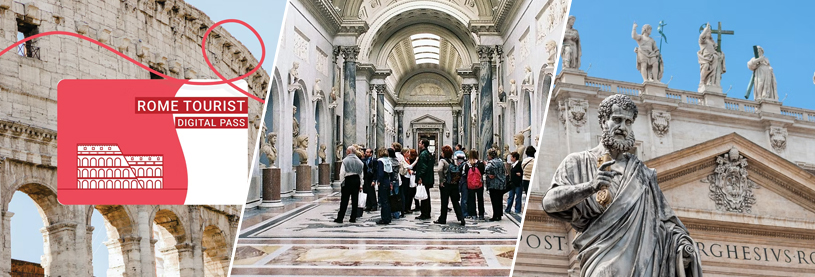
Rome tourist card
Rome wasn't built in a day, but you can see the best bits of it in one! Snap up the Rome Tourist Card and you'll get everything you need to explore Rome's top highlights. You can even choose the order you see things in, making it perfect for planning your own custom adventure.

Save money

100% digital

Hand-picked combinations
The Colosseum: The Symbol of Rome from the Very Beginning
The original name of the Colosseum is Flavian Amphiteater, as it was built by two emperors (father and son) belonging to the Flavian family. Its construction began around 70 AD under Vespasianus and ended in 80 AD under Titus’ reign. The valley where it was built wasn’t just in the center of Rome, but also, as we will see, highly symbolic.

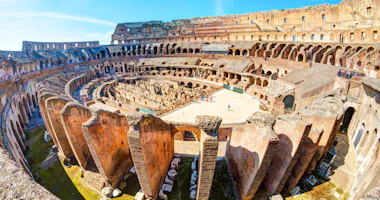
The structure is made of travertine and stone blocks, and it was originally covered with the finest marbles adorned with statues and stucco decorations. On the outside, it features four tiers of overlapping arches, and on the inside, the bleachers were covered in marble.
On sun scorched days, the top of the Colosseum was covered with 80 gigantic awnings, thanks to a complicated support system operated by pulleys . Under the arena, there were galleries and rooms to keep the animals and the stage props. With the aid of freight elevators, the gladiators and the animals were brought up from the underground, directly to the middle of the arena: definitely a sensational effect for the audience attending the show.
The monument got the name of Colosseum, because it was erected near a huge bronze statue of Nero covered in gold, which was 35 meters in height , called “the Colossus”. After his death, the statue has been partially reworked to take the appearance of the God of Sun. Years after, it was completely destroyed, maybe because of an earthquake or a Barbarian sack. The remains of the base of the statue were discovered and unearthed just 40 years ago, and it's now visible.·
In fact, just before Vespasianus, Rome’s emperor was the infamous Nero. Even if his figure has recently been partially cleared, as apparently he wasn’t meaner or more authoritarian than most of his predecessors and successors, his reign was dominated by ordeals, homicides of politicians and members of his family. He built a monumental residence for himself (the Domus Aurea) between the Palatine, the Oppian Hill and the valley in between. When Rome was razed by a great fire in 64 AD, which was most probably an arson not caused by Nero, he accused and executed hundreds of Christians, to avoid being held responsible for that disaster. He was killed in 68 AD at just 28 years of age, after 9 years of reign. His house ended with him.
When Vespasian was finally elected as the new emperor of Rome, the senate wanted to erase any trace of the predecessors. They destroyed Nero’s residence. On the very spot where the heart of Nero’s delusions of grandeur stood, the emperor wanted to build a large amphitheater, the largest ever built, to symbolically give back Rome to its citizens. During the official opening, the games, battles and shows lasted for 100 days.

Main Shows and Events
The shows at the Colosseum included the battles of animal vs animal, men vs beasts and men vs men. There were also acrobats and musicians’ performances and, later in the day, public executions. On some occasions, the arena of the Colosseum was flooded to perform the “naumachia”, a battle between warships. It took about 7 hours to fill the area with water, with the aid of a complicated system of underground conduits.
Below the arena, there were cages where the beasts were prepared for their exhibition: it is estimated that for the opening games alone, around 5,000 animals were killed. The animals were brought to the arena via a lift while the gladiators walked up to the battleground through walkways. Among the animal species that were brought to the Colosseum, many came from faraway conquered lands: lions, tigers, giraffes, stags, antelopes, bears, wolves, buffalos and elephants.
The gladiators were slaves, war prisoners, those sentenced to death or even free citizens wanting to achieve glory and gold with a victory. They were trained how to fight in a gladiator school. The day before the show, the organizer offered a free banquet open to all citizens. This was also the chance to have a closer look at the gladiators and make betting choices accordingly.
Admission to the Colosseum shows was free. All expenses were usually paid by the emperors. The Colosseum has four levels and it had a seating capacity of 50,000. The spectators were seated according to their social status. The ordinary onlookers and the working class had to sit at the upper levels while the senators, the aristocracy and the priests were seated near the ground level, to have a clear view of the arena. The games were used by emperors to entertain the public, but also to foster their popularity.
The rule of the gladiator fights was simple: the last man standing was the winner, and losers were doomed to die. However, in some instances, when the loser survived from being defeated by his opponent, the emperor was the one to determine his fate. Most of the time, the emperor looked at the audience to see what the majority of the crowd wanted, before deciding. A thumb’s up from an emperor meant that the loser had been given the chance to live. If it was the other way around, the winner had to kill the loser.
Even emperors sometimes took part in the fights, since the games were viewed as a symbol of prestige and power. The emperor Commodo, for example, a real fan of the gladiators, used to participate in the clashes and sometimes stayed at the Ludus Magnus, the residence and training facility of the fighters.
The bloody gladiators’ battles ended in 404 AD thanks to the emperor Onorio, when a man, S. Telemaco, jumped into the arena trying to stop the massacre. The public was outraged by Telemaco’s actions and furiously stoned him to death. Onorio was so impressed by the cruelty of his citizens, that he decided to finally end the long history of the gladiators’ deadly fights. Since 2000, the Colosseum features a special lighting show each time a State in the world decides to abolish the death penalty.
After the Empire: The Decline
When the Empire declined, so did the Colosseum’s splendor. The site became a shelter and a hiding place for criminals. Legends of the time identify the Flavian Amphitheater as one of the seven gates to hell, where the restless ghosts of the gladiators wandered through the arches and in the underground tunnels.
Later, the marbles and statues that adorned the monument were removed and used as construction materials. The powerful Barberini family decreed a massive looting of the Roman monuments, including the Colosseum, to build the S. Peter’s Basilica and the Barberini Palace. Actually, there’s a saying which goes, “what the Barbarians did not, did the Barberini”. Pope Benedict XIV then stopped the looting in the 18th Century. Later, Pope Pius VII commissioned the propping of the outer walls. This work was continued by later popes.


The Colosseum and Christianity
The monument’s sinister reputation came to an end in the Jubilee year 1675, when the place slowly became a place of worship, in the memory of the many Christians who found their death here. Pope Benedict IV commissioned the construction of the Way of the Cross shrines. Finally, in 1749, the Colosseum was consecrated to Christ and the Martyrs. A simple cross was positioned in the middle of the old arena.
It has to be noted that, even though the Colosseum is not a church anymore, a very evocative and enchanting night procession of the Way of the Cross, attended by the pope, has been held every year since the middle of the eighteenth century on Holy Friday, and it’s still a living tradition today.
In the Colosseum there is a small chapel, that has been recently restored, dedicated to the Holy Mary, hosted inside one of the arches. This tiny church probably has a very ancient origin, as there are accounts of it dating back to the sixth century AD.
A Monument by Definition
Today, the Colosseum is not only the symbol of the city, but one of the most visited destinations. Tripadvisor has recently named it the most popular tourist site in the world. The charming effect of this place is due to the history that it has witnessed. It’s one of the landmarks of Western culture, a reminder that we all have the same roots. In ancient times, there have been very few places of the known world that haven’t been touched by the Roman Empire.
While walking beside it and the Forum, one can only imagine how this area used to look. As a term of comparison, we use what we already know, which is probably not enough to explain the shiny and colored marbles, the massive buildings, golden statues, hundreds of columns, sculptures and stuccos which adorned the center of Rome, namely the center of the world.

The Colosseum in Popular Culture
Romans still feel a sense of admiration and sincere devotion towards the Colosseum. During the day, the shadow of its imposing mass, the city still lives and bursts, while at night, it’s common to just drive around as part of the Rome by night tour, basically a romantic promenade on four wheels, passing by the main landmarks in town.
The monument has been featured in countless works of art, including many blockbusters, since the ‘50s. One of the most celebrated movies of the contemporary era, and rightly so, is the Oscar award-winning 'Gladiator', by Ridley Scott (2000). This film, has contributed to light another huge spotlight not only on the monument itself, but on ancient Rome’s customs and culture. The story of the main character well depicts the fate and gestures of one of the many gladiators that were admired during the battles and brutal shows. One of the most remarkable quotes about the monument is delivered by a senator: "The beating heart of Rome is not the marble of the Senate, it’s the sand of the Colosseum".
There’s a saying which comes from an old prophecy written in the eighth century AD by Beda the Venerable, a monk from Sunderland in the UK, that reads: "While the Colosseum stands, Rome shall stand, when the Colosseum falls, Rome shall fall; and when Rome falls, so will the world." Despite the fact that this prediction probably referred to the cultural influence of the city, and not the monument itself, it has to be said that, whenever this monument need works to preserve its integrity, the council administration always deliberates and acts very quickly!
It’s still a common expression call someone with an imposing and massive build "gladiator". The epithet has no negative value: on the contrary, it’s a compliment, as it means that, despite the strength and muscles, the person has a kind and benevolent manner. In a way, this perpetuates the way in which gladiators were perceived in ancient Rome: fighters and heroes.


The New Findings and The Museum
As it happens for all major historical sites in Rome, the Colosseum is still under active investigation by archaeologists. Following recent excavations and findings, a museum has been housed on the second level of the amphitheater, which features an itinerary to learn and understand the history and use of the monument across the centuries.
There are multimedia installations and fragments, such as barriers, and also the reconstruction of one of the vomitoria (the public access to the amphitheater), with the aim to show how the Colosseum has been a model for later architectural styles. Just to give you an example, the vomitoria, which allowed a large number of people to quickly enter and leave the stadium, have been replicated in the structure of the contemporary stadiums. Here, you’ll also be able to observe fragments of the rich decoration that once adorned the site.
The museum features works of art inspired by the Colosseum and made by prominent artists, such as the french painter Hubert Robert. There is also a section with the reproduction of scenes of gladiators’ daily life and battles ,and a schematic of the audience seating system, depending on social status and ranking.
How to get to the Colosseum
Reaching the Colosseum is easy. Just take the subway (Line B) and get off at the stop called Colosseo. If you are already in the historical center, the monument is within walking distance from the Palatine Hill and the Forum.

FAQ
-
How much does a ticket to the Colosseum cost?
A ticket for the Colosseum costs € 23,50 if you buy your tickets online. At the box office of the Colosseum, a ticket costs € 16, but take into account a long queue if you buy your ticket on the spot.
-
What sights are near the Colosseum?
Near the Colosseum is the Roman Forum and Circus Maximus
-
How do I get to the Colosseum?
You take the Metro line B and get off at the Collosseo stop
-
How many people can the Colosseum hold?
The Colosseum has the capacity for three thousand visitors
You might also like

Gladiator School
Always wanted to know what it’s like to be gladiator? On the Gladiator School, you will learn all about the life of the gladiators of ancient Rome.
Read more...
Excursion Old Rome And The Colosseum
On this particular tour, the guide will take you to all the important sights of Ancient Rome like the Palatine Hill, Roman Forum, the Circus Maximus
Read more...
Top Rated Hotels near Colosseum Roman Forum
There are many hotels and holiday residences that you can find at Rome’s center, which are just a quick stroll away from the main spots in Rome.
Read more...
Monuments Rome
Rome has proven itself to be a strong city, judging by its monuments that have withstood the test of time. Not all monuments in Rome are that lucky
Read more...