Tours
More excursions & tours-

Rome Tourist Card
Rome Tourist Card
Snap up the Rome Tourist Card and you'll get everything you need to explore Rome's top highlights including Colosseum, Palatine Hill, Roman Forum and Hop on/off bus. You can even choose the order you see things in.
read more... -
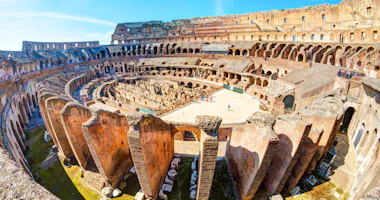
Colosseum, Roman Forum
and Palatine Hill: Skip lineColosseum, Roman Forum
and Palatine Hill: Skip lineSkip the long lines at the Colosseum with this priority-entrance ticket. This ticket will let you bypass the crowds. And after exploring the Colosseum you can head to the Roman Forum + Palatine Hill and enter directly
read more... -

Vatican Museums & Sistine Chapel: Skip The Line
Vatican Museums & Sistine Chapel: Skip The Line
Save time and stress with priority entrance and skip the line. Admire countless masterpieces by Michelangelo, Raphael, Caravaggio, Tiziano, and the Sistine Chapel.
read more... -

Borghese Gallery
Fast TrackBorghese Gallery
Fast TrackGalleria Borghese is located in Villa Borghese park. Admire the architecture and furnishings of this beautiful villa, home to a rich collection of Renaissance art, sculptures, and paintings. Get tickets weeks in advance due to limited capacity.
read more... -

St. Peter's Basilica:
Express Guided TourSt. Peter's Basilica:
Express Guided TourExperience the St. Peter’s Basilica with this express guided tour that includes reserved entrance, allowing you to bypass long lines and make the most of your time.
read more...
Capitoline Museums
Capitoline Museums
Current visitor information
Checked
Plan your visit
The treasure is hidden at the top of the flight of stairs. Michelangelo, in the mid-sixteenth century, decided that people visiting the cradle of Roman culture and history, had to climb the Cordonata, a sloping road featuring low steps, to reach a perfect scene, where, together with a stunning view, you’ll finally meet its origins. This is the exact spot where Rome was originally built, here is where it all began. When you arrive at the top of the hill, you won't feel any fatigue, but just the desire to open up the treasure chest and see what’s hidden inside. This is the Capitolium Hill (Campidoglio), and today we are going to explore the wonders of the Capitoline Museums.
Before you Enter the Museum
Before you plunge into one of the greatest art collections of the world, I’ll invite you to discover one of my favorite sightseeing spots. After passing the marble statues of the Dioscuri (Castor and Pollux) sitting at the side of the stairs and the equestrian statue of the Emperor Marcus Aurelius, head toward the right of the Capitol building and take the narrow Via del Campidoglio. After only a few meters, get the camera ready, because Rome finally opens up.
Here you are, standing on the Capitolium Hill, just like a senator before an assembly, looking out to the Palatine Hill, the Valley of the Forum Romanum, and, in the distance, the Colosseum. Here, you get the impression that nothing else exists but the greatness of ancient Rome. Take some time to let your eyes enjoy the scenery, where the modern age hasn’t left any notable mark.

The Museums
And now, let’s walk back to the square, where you will find the Town Hall and two almost identical buildings, facing each other: the Palazzo dei Conservatori and the Palazzo Nuovo, which are, together with the Lapidaria Gallery, the main exhibition venues of the Capitoline Museums .
Palazzo dei Conservatori
With your back to the Town Hall, you will see the Palazzo dei Conservatori on your left. This is where we will start our journey inside the museums. Here, the collection is so rich, that, in this article, we will carefully select some of the main pieces of artwork. The building was originally built in the fifteenth century, and then completely renovated by Michelangelo, whom died before the works ended. His project was carefully carried out and completed in 1568 by the famous architect and sculptor Giacomo della Porta.


The palace has a large patio, where you will be face to face with the remains of a statue that is often depicted on the front cover of school history books (at least in Italy!) and travel guides of Rome. We’re talking about the huge statue of Costantine, the first Christian Emperor, sitting on a throne. He commissioned this enormous monument between 313 and 324. The remains include, among other pieces, the huge head, a hand, an arm and the feet, and were discovered back in 1486. The reason why only these elements have survived is that the statue was created using a particular technique: only the bare parts were made of marble, while the rest was a supporting structure covered by a bronze drapery or simple stucco.
Costantine’s eyes are wide open, and looking up, as if he is trying to connect with a supernatural world. Compared to the previous Roman portraits, the traits of his face are unrealistic and idealized: the expression is more important than reality, as beauty now has to be found in another dimension. After all, lest we forget, Costantine is the link between Christianity and the Empire. On the other side of the patio, there is a group of colossal statues and some marble reliefs, all of them belonging to the era of the Roman Empire.
“
Statue of Marcus Aurelius
The statue you admire in the middle of the square is a very recent copy of the original, which is visible inside the museum. Built in 176 AC, it was probably originally situated in the Forum Romanum or in the Colonna Square and it’s the only statue of its kind that has survived, perfectly preserved, until the modern age. The statue is made of bronze and it was saved from being melted down by the ecclesiastical administration, just because it was mistakenly attributed to Costantine, the first Christian Emperor.)
In the building, you will also be able to visit the Apartment of the Conservatori, which was used as a judicial state room. This venue is currently the location for official ceremonies and events. The two main rooms are the Oriazi and Curiazi Hall and the She-Wolf Hall (Sala della Lupa). Together with the acronym S.P.Q.R. (which means Senatus Populus Que Romanus – The Senate and the People of Rome), the Lupa is a powerful symbol of the city, and you will find it in various forms, in many different locations around town.
The bronze statue represents a she-wolf feeding the twins Romulus and Remus, the founders of the city. In a past where the sequence of events doesn’t follow a linear pattern, the foundation of Rome is linked to a specific date, amazingly confirmed in various chronicles and history books written across the centuries: April the 21st, 753 BC. Of course, this is a purely conventional date of birth, but apparently is also the result of complicated astrological calculations made in the first century BC. Today, the city council still celebrates what is known as the Christmas of Rome, with events around town.
·


If the “when” is so incredibly well accounted for, the “how” is definitely more legendary. The baby twins Romulus and Remus were the heirs to the throne of Alba Longa, a town on the Alban Hills, approximately 20 kilometers south of Rome. They were the illegitimate sons of Mars (the deity of war) and a vestal virgin, Rea Silvia. His uncle, currently sitting on the throne, fearing to be ousted by the twins, ordered their killing. But the man that was supposed to slay them was moved to pity, spared their lives, and abandoned them in a basket on the Tiber river. Romulus and Remus were rescued and fed by a she-wolf, which, guess what, was an animal sacred to the god Mars. When they grew up, they managed to kill their evil uncle and, shortly after, founded Rome, a small settlement on the Capitolium and Palatine Hills.
The statue of the Lupa was dated 300 BC up to a decade ago, but recent examinations made with the latest technologies have shown that it was probably crafted in the tenth century. The twins were added later on, around 1490. Even if it has been moved around, the bronze statue has always been cared for, with constant treatments to preserve its integrity. Experts do not completely rule out the possibility that, under the more recent bronze layers, there is a much older structure.
Palazzo Nuovo
It’s not strictly necessary to learn everything about a particular piece of art to be able to appreciate it and enjoy its beauty. But sometimes, when discussing ancient art, we forget this: it’s all about understanding exactly what it depicts and the history behind it. In reality, those statues and paintings were made to celebrate creativity and to amaze the person who came to admire it. The bottom line is: I suggest you to read the descriptions at the base of a statue, but sometimes it’s better to simply look at its marble gaze, and just get carried away.
Forget an exhibition divided by historical periods or sculpting and painting techniques: the Palazzo Nuovo is a celebration of art. Every historical period, from ancient times to the nineteenth century is well represented here. Even the exhibition itself is a quantum leap in the past, as the arrangement that you see is dated back to the seventeenth century!
Palazzo Nuovo is a gem in terms of the abundance of statues and paintings. Built according to a project signed by Michelangelo, this building was the destination of artworks coming from private collections. Among all these treasures, here is what you can’t miss:
THE DYING GAUL - The Romans admired Greek art so much that, during the Empire, many artists were commissioned to create copies of famous Greek original artworks. In many instances, the original has not survived the course of time, whilst the copy is still here to be admired. The fact that it’s a copy does not diminish its artistic value, as its crafting required the highest level of sculpting. One of these statues is the Dying Gaul, which is probably one of the most evocative of the entire collection. The original was made to celebrate the victory of Attalus, the king of Pergamum in Asia Minor, over the Gauls, who had invaded the Persian kingdom. I just find it incredibly modern: by depicting a powerful, yet dying soldier, it acts as a perfect and sad reminder of the atrocities of war.
THE PHILOSOPHERS’ HALL - Here, you will be in the presence of 79 marble busts depicting philosophers, poets and prominent personalities of the ancient world, such as Socrates, Cicero, Homer and Pythagoras. How nice it would be if these finely crafted stones could talk and answer our questions!
THE EMPERORS’ HALL - Most of the Roman Emperors are gathered in this “congress” which goes beyond the boundaries of space and time. Among the 67 busts and statues, you’ll find Augustus, Nero and Trajan, plus some of the most famous “first ladies” and noble women of the Empire, such as Livia (Augustus’s wife) and Agrippina. It’s not only an astonishing gallery of portraits, but also a journey into the history of fashion and costume in ancient Rome.
THE VENUS - This idealized, yet naturalistic marble statue is inspired by the Venus of Prassitele. This famous Roman statue has traveled to Paris, due to Napoleon’s victorious campaign in 1797, but, fortunately, it was one of the lucky ones that was brought back home by direct intervention of the Congress of Vienna (1815) and the famous sculptor Canova.
The Lapidary Gallery (Galleria Lapidaria)
The underground corridor that connects the two buildings was dug in the thirties, at about 8 meters under the Capitolium Square. Here, there is an incredible collection of Roman inscriptions, belonging to the most diverse spheres of the Imperial life: graves, religion, the army, Roman aristocracy, arts and crafts, games and much more. When the tunnel was excavated, some remains of old domus (Roman houses) where found, and are now visible.
There are so many archaeological layers in Rome, that almost everywhere you dig, there is something to be found. We started this journey finding a treasure at the top of the stairs, we have ended up 8 meters underground, and there are still so many things to see!
“
The Legend of the Capitolium Geese
Did you know that the geese are the heroines of a very well-known legend? In 390 BC, Rome was beseiged by the Gauls, and the Roman army and population took refuge on the Capitolium Hill. One night, a messenger who was coming back to Rome after being sent to alert a distant detachment of the Roman army, was secretly followed by the Gauls, who were determined to attack the hill. This is when a large number of geese, the only animals that survived the starvation of the population and were therefore still alive, started to squawk loudly. The noise alerted the Romans and the attack was miraculously repulsed. This event was the start of a successful comeback of the Roman army. Today, when someone speaks loudly, apparently complaining about something in a disorderly manner, it is compared to the Capitolium geese!)
After the Visit to the Museum
Your visit to the museum will probably take a few hours. Still, it depends on how much time you spend in each location. Afterwards, you can pay a visit to another palace, just behind the Palazzo dei Conservatori, called Palazzo Caffarelli, which is technically another wing of the museum, but it's best known for its panoramic cafeteria and restaurant at the very top of the building.
When satisfied with your daily dose of history and art, you can return to the present and enjoy some serious shopping or fine food. Via del Corso is just a stone’s throw away, with all its shops (mainly fashion and shoes), ranging from famous brands, to sophisticated boutiques and small bargain stores.
If you cross Venice Square and take the first road on your right, Via dei Santi Apostoli, you’ll end up in front of one of the nicest pubs in Rome. It’s called Nag’s Head, and, yes, a Scottish pub by name, but with a great Italian twist. The menu includes the best of Italian and Scottish cuisine and the atmosphere is always very lively. The prices are not exactly cheap, but, considering the location, very fair indeed.·


Visiting Hours
Tuesdays to Sundays from 9.00 to 20.00
December 24 and 31, the museum is open from 9.00 to 14.00
The museum is closed on Monday, December 25, January 1 and May 1.

Capitoline Museums: Entry Ticket
Capitoline Museums: Entry Ticket
Welcome to the world’s first museum! The Capitoline Museums (plural because it's in four buildings atop one of Rome's famous Seven Hills) has a fascinating collection of art and artifacts all telling the fascinating history of Rome.
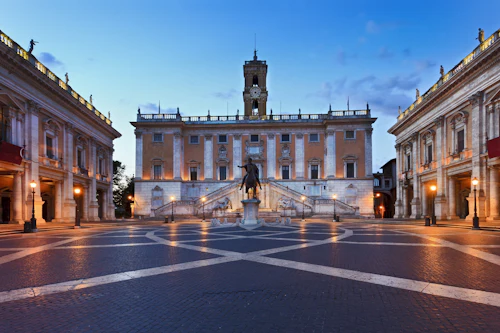
Capitoline Museums: Guided Tour + Multimedia Video
Capitoline Museums: Guided Tour + Multimedia Video
Unleash the inner explorer and dive headfirst into an immersive multimedia presentation that catapults everyone right into the heart of ancient Rome. Let the rich history and meticulously reconstructed monuments of this grandiose city seize the senses and paint a vivid picture of its glory...
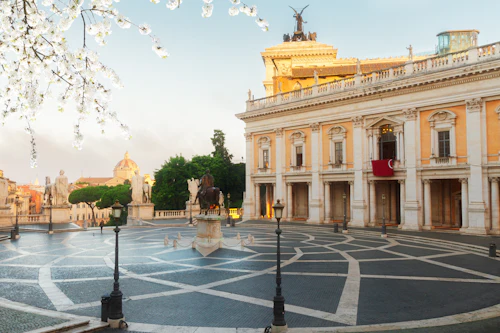
Capitoline Museums: Skip The Line Ticket + Multimedia Video
Capitoline Museums: Skip The Line Ticket + Multimedia Video
Welcome to the oldest museum in the world. The Roman Empire Museum (Musei Capitolini) dates all the way back to 1471, making it the first art museum in history. Located at the summit of Capitoline Hill for almost 600 years, this gallery affords timeless views of the Eternal City, and is a...

Capitoline Museums: Hosted Entry Ticket + Audio Guide
Capitoline Museums: Hosted Entry Ticket + Audio Guide
Visit the Capitoline Museums on Capitoline Hill in Rome to see its extensive collection of ancient Roman sculptures, Renaissance artworks, and archaeological artifacts. Before entering, meet your host at the designated point to collect your admission tickets and get help setting up your digital...

FAQ
-
Where are the Capitoline Museum?
The Capitoline Museums are in Rome, located at the top of the Capitoline Hill, in the historical center of the city.
-
What's in the Capitoline Museums?
When you visit the Capitoline you will be able to admire the monumental statue of the Emperor Costantine, the Lupa (the she-wolf), which is the symbol of Rome and the equestrian statue of Marcus Aurelius. The museums also features an incredible collection of works of art from ancient Rome, up to the nineteenth century.
-
How can I reach the Capitoline Museums?
The Capitoline Museums are located next to the square called Piazza Venezia. You can catch one of the following bus lines: 170, 30, 60, 716, 80, 87.
-
What are the Capitoline Museums opening hours?
The Capitoline Museums are open to the public from Monday to Sunday, from 9,30 am to 7,30 pm.
-
Can I buy Capitoline Museums tickets online?
Yes, you can buy Capitoline Museums tickets online. You can also buy a combi ticket to visit the museums and other attractions of the city.
You might also like

Capitoline Hill
The Capitoline Hill is the smallest among the seven hills of Rome. You can find it near the Roman Forum. The current appearance of the Capitoline Hill is primarily determined by Michelangelo’s Piazza del Campidoglio, including the construction of the square as well as the renovation of the several existing buildings.
Read more...
Museums in Rome
The city of Rome is a one, big museum in itself. Just by walking in its streets and strolling in its piazzas, you can get a taste of Rome’s rich history.
Read more...
The Vatican Museums & Tickets
The Vatican museum consists of several pontifical museums and galleries which are open for public viewing. Several popes founded the museums
Read more...
Castel Sant’Angelo
Castel Sant’Angelo also known as Angel's Castle, this is where you can get one of the loveliest views of Rome whether it may be during the day or at night.
Read more...