Tours
More excursions & tours-

Rome Tourist Card
Rome Tourist Card
Snap up the Rome Tourist Card and you'll get everything you need to explore Rome's top highlights including Colosseum, Palatine Hill, Roman Forum and Hop on/off bus. You can even choose the order you see things in.
read more... -
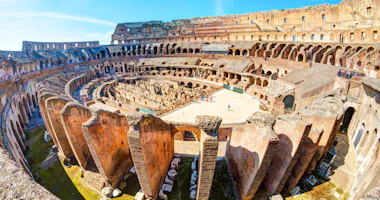
Colosseum, Roman Forum
and Palatine Hill: Skip lineColosseum, Roman Forum
and Palatine Hill: Skip lineSkip the long lines at the Colosseum with this priority-entrance ticket. This ticket will let you bypass the crowds. And after exploring the Colosseum you can head to the Roman Forum + Palatine Hill and enter directly
read more... -

Vatican Museums & Sistine Chapel: Skip The Line
Vatican Museums & Sistine Chapel: Skip The Line
Save time and stress with priority entrance and skip the line. Admire countless masterpieces by Michelangelo, Raphael, Caravaggio, Tiziano, and the Sistine Chapel.
read more... -

Borghese Gallery
Fast TrackBorghese Gallery
Fast TrackGalleria Borghese is located in Villa Borghese park. Admire the architecture and furnishings of this beautiful villa, home to a rich collection of Renaissance art, sculptures, and paintings. Get tickets weeks in advance due to limited capacity.
read more... -

St. Peter's Basilica:
Express Guided TourSt. Peter's Basilica:
Express Guided TourExperience the St. Peter’s Basilica with this express guided tour that includes reserved entrance, allowing you to bypass long lines and make the most of your time.
read more...
Spanish Square
This is probably going to sound a bit unconventional, but I’m convinced that if Rome was a villa, the Spanish Steps would be its private lounge. Life is sweet, and must be enjoyed. When you travel to Rome, it’s a pity to be on a tight schedule. And, even if you are, try to find time to come to the Spanish Steps. Once you get here, you’ll simply realize that this is one of the many alchemical doors of the city. A door that opens to reveal hidden secrets, romantic atmospheres and stunning views.
Spanish Square
If you choose your itinerary around this district (called Campo Marzio) we suggest that you arrive from the Via del Babuino, a narrow street which begins in Piazza del Popolo (LINK HERE) and ends up here. Once you arrive at the square, the scenery opens up like a theater stage full of real life. This is a luminous and popular place, perhaps the most joyful and happy square of the entire city. Here, people are part of the artistic performance of Rome.
Shortly, we are going to get to the most famous monuments, such as the Spanish Steps and the church at the top of them, the fountain and the obelisk, but first, let’s just stop for a while to admire the wholeness of the square, with its peculiar bow tie shape and the color palette of the buildings, ranging from warm ocher to yellowish and beige. In fact, the best time to visit the square is probably in the late afternoon, to see how the light changes the shades of the buildings around you, and the color becomes more full and dramatic.
Te square is named due to the presence of the seat of the Spanish Embassy in the Vatican, whose palace was built precisely for this purpose back in 1647 by the architect Antonio del Grande. The buildings surrounding the square are all dated somewhere between the Seventeenth and Nineteenth centuries. Here, you’ll also find an obelisk dedicated to the Virgin Mary and the church of Trinità dei Monti.


The Spanish Steps
The steps start at the Piazza di Spagna and lead up to the French church, Trinità dei Monti. There’s a reason why this is a popular destination for couples (especially on a first date): even if you happen to have the most rational mindset, I bet you’ll be softly struck by a strange feeling. If I had to translate it into words, I would probably call it an “instinctive romanticism”, a mix of pensive nostalgia, serene acceptance and admiration. Baroque, in its opulence, usually overwhelms the visitor, but here it’s in perfect harmony with human diversity, with its indistinct voices, colorful outfits and constant movement, teeming with life.
The Spanish Steps were designed by Alessandro Specchi and Francesco de Sanctis, after troubled discussions on how to solve the problem of the steep slope between the church of Trinità dei Monti and the square below. In flawless baroque style, its monumental nature is slowly revealed, as we begin to climb its 135 steps. The aristocratic nature of the Spanish Steps can be admired in its game of eye-catching perspectives and scenic effects.
Thanks to significant funding from the French monarchy, the Spanish Steps were completed during the 1735 Jubilee . It took a while before the steps were built due to a disagreement which arose between the French financiers and the Pope. The original plan was to erect a statue of the French King (Louis XIV) at the top. However, Pope Innocent XIII was displeased with the plan and objected to the proposition. Eventually, they reached an agreement and decided to make a garden-terrace instead.
Just like it was in the past, both tourists and locals alike enjoy sitting and lingering on and around the steps to soak in the place’s romantic ambience and to enjoy the scenic view of caricature artists and street vendors working at the foot of the steps. It is a popular destination for pilgrims, artists and writers who are seeking inspiration to write and paint.
“
From the beginning, this place was admired and visited by many European poets, writers and artists. Goethe, Stendhal, Shelley, Keats, Byron and Oscar Wilde have come here to visit, find inspiration, and, in some instances, have chosen this place as their residence. To the right and side of the steps, is the House of Keats and Shelley: a little treasure, and a museum, not to be missed.
Special Recurring Events
If you come to the Spanish Steps during spring (approximately from the beginning of April to mid May), you’ll be surprised by the Infiorata, when the steps are overshadowed by hundreds of azaleas in full bloom. During summer, the steps become a catwalk for a posh fashion show, while in December, during the feast of the Immaculate Conception, the Pope pays homage to the statue of the Virgin Mary at the top of the obelisk on the square, laying a wreath of flowers and then giving his blessing to the people.
The “infiorata” is a baroque Italian tradition that belongs to many cities and smaller towns. The square, streets and alleys are completely covered with artistic compositions of flowers. One of the most beautiful “infiorata” in Italy is the one held in Genzano, a small town at about an hour's drive from Rome, in the Castelli Romani area, which is definitely worth a visit.

Palazzo Zuccari: a Touch of Bizarre Architecture
When you arrive at the top of the steps, you’ll need some time not only to relax, but also to admire the panorama, as far as the eye can see, of domes, and monument sand roofs. Before heading to the church or sitting down in a cafeteria for some refreshments, I suggest you take the first, narrow street on the right. It’s called Via Gregoriana, and if you have kids with you, tell them you’re heading to the “monster’s palace”.
Here, approximately twenty meters to your left, you’ll find Palazzo Zuccari. On the facade, the portal surrounded by marble sculptures looks like a monster that is about to eat you! The whole building was conceived by the eccentric Federico Zuccari back in 1590. He was a painter and a scholar, fascinated by esoteric practices. That’s why he built a very special themed mansion to celebrate the bizarre and the grotesque. Whomever enters the door is invited to leave behind his prejudice, and to open himself to a different way to see and interpret the world. In a way, it is an invitation to be enriched by culture, studies and intellectual attitude.
Today, the building can only be visited by guided tour, and hosts one of the largest Italian art libraries, the Hertz Library, with more than 300,000 books and 800,000 photographs. Inside, the building has been renovated, but the left wing still features the frescoes made by Zuccari himself.·
And, if you are lucky to be able to book a tour here, you’ll be able to visit the terrace, which is probably one of the most beautiful views in town, a real privilege for the few!


The Church of Trinità dei Monti
The steps lead up to a church called Trinità dei Monti, which is one of the five Roman churches where the mass is officiated in both Italian and French. The construction of this sacred place started in 1500, by the will of the French king Charles VIII, who wanted to thank the monks of the Minimi Order for the spiritual guidance provided to his family. At the time, after some pretty big conflicts, the Vatican and the French monarchy seemed to have found some harmony, hence the generous allocation of funds directed to the Roman monuments.
The architects (Lippi and Canonica) used stones proceeding from the French city of Narbonne. The interior of the church is a unique example of late French Gothic style, which is not present anywhere else in Rome. The facade has been deigned by Giacomo dalla Porta and Carlo Maderno, who enriched the church with the two twin bell towers. Trinità dei Monti was finally consecrated in 1585.
Considering that the main “sponsor” of both the church and the steps was the French administration, one would argue as to why the steps were named after the Church (Trinità dei Monti), and later on after the name of the square (hence “Spanish”). There is no clear answer; it’s just the way traditions shape - and sometimes change and forget - the things of the past. If we were a tad malicious, we could look at the relationship between the Pope and the French monarchy, which has had its ups and downs, but this is probably not the place to bring it up, and the conflicts between the two had long ended by the time these monuments were built.
The Barcaccia Fountain
The Barcaccia fountain is shaped like a sinking ship in a basin and built at the request of Pope Urbano VIII in 1598, to commemorate the tragic (and frequent) floods caused by the river Tiber. The Barcaccia was built and designed by Pietro and his son, Gian Lorenzo Bernini. The floor of the outer basin lies under the pavement level and the fountain looks like a sinking boat. Apparently, the inspiration came to Pietro Bernini from a stranded barge which ended up on the square after a flood.

The Column of the Immaculate and the House of Keats and Shelley
This column, created around 1850 by Luigi Poletti, is situated at the left of the steps, in front of the smaller and adjacent Mignanelli Square. This square is host of the Valentino Haute Couture shop and headquarters. Between Piazza Mignanelli and the Spanish Steps, at number 26, you’ll be able to visit the famous Shelley and Keats House museum, which was residence of the poets during their stay in Rome, and where John Keats died. The first personality to recognize this place as a site to be treasured in memory of the poets and their contemporary literary current, was Oscar Wilde, who visited this house during his trip to Italy.
Travel Tips
Fancy a picture on the Spanish Steps with no one around you? As retouching the photo will be impossible, I suggest you come here early on a summer's morning (around 6!). The sun will already be up, and I promise you lucky early birds are going to be (almost) completely alone in this magnificent and silent place.

You might also like

Restaurants in Rome
You can find a considerable number of exclusive restaurants in Rome, pizzerias and cozy hostelries within the city’s vicinity.
Read more...
Piazza del Popolo
The Piazza del Popolo is an important central square in Rome. Originally, it was one of the city's entrances. It was designed by the architect Giuseppe Valadier and it includes three churches, fountains and an obelisk.
Read more...
St Peters Square
Vatican City’s gigantic square, the St. Peter's Square was built by Gian Lorenzo Bernini. The Square has two fountains that are almost identical.
Read more...
The Vatican Museums & Tickets
The Vatican museum consists of several pontifical museums and galleries which are open for public viewing. Several popes founded the museums
Read more...