Tours
More excursions & tours-

Rome Tourist Card
Rome Tourist Card
Snap up the Rome Tourist Card and you'll get everything you need to explore Rome's top highlights including Colosseum, Palatine Hill, Roman Forum and Hop on/off bus. You can even choose the order you see things in.
read more... -
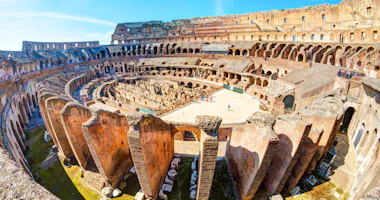
Colosseum, Roman Forum
and Palatine Hill: Skip lineColosseum, Roman Forum
and Palatine Hill: Skip lineSkip the long lines at the Colosseum with this priority-entrance ticket. This ticket will let you bypass the crowds. And after exploring the Colosseum you can head to the Roman Forum + Palatine Hill and enter directly
read more... -

Vatican Museums & Sistine Chapel: Skip The Line
Vatican Museums & Sistine Chapel: Skip The Line
Save time and stress with priority entrance and skip the line. Admire countless masterpieces by Michelangelo, Raphael, Caravaggio, Tiziano, and the Sistine Chapel.
read more... -

Borghese Gallery
Fast TrackBorghese Gallery
Fast TrackGalleria Borghese is located in Villa Borghese park. Admire the architecture and furnishings of this beautiful villa, home to a rich collection of Renaissance art, sculptures, and paintings. Get tickets weeks in advance due to limited capacity.
read more... -

St. Peter's Basilica:
Express Guided TourSt. Peter's Basilica:
Express Guided TourExperience the St. Peter’s Basilica with this express guided tour that includes reserved entrance, allowing you to bypass long lines and make the most of your time.
read more...
The Maxxi Museum
If you think Rome is all about ancient history, it’s time to think again. The Italian capital is known as the Eternal City in part because it has remained relevant throughout millennia. As the world evolves, so does Rome - as showcased by its love for new and exciting forms of art. Modern and contemporary art and architecture certainly have a place in Rome, in the world-renowned MAXXI Museum. Officially called the Museo Nazionale delle Arti del XXI Secolo (National Museum of the 21st century arts), the MAXXI Museum Rome is one of its kind. Not only does it include key pieces in its collection, but the building itself is also a piece of art.
Thanks to its innovative design, MAXXI is beloved by architects and aficionados throughout the world, not unlike Bilbao’s Guggenheim
Museum. MAXXI is actually divided into two museums: one dedicated to contemporary art, and the other to architecture. The beautiful outdoor
spaces between both areas are dedicated to temporary exhibits of larger pieces, including sculptures and other installations.


The MAXXI Museum Architecture Wonder
For millennia, Rome was at the forefront of innovation in regards to architectural elements. Architects come from all over the world to
witness the history of buildings within the ruins and old churches of the Eternal City. So, when it was time to give the 20th and 21st century
arts a new home, it was clear tradition had to be upheld!
Italy’s Ministry for Cultural Heritage created a two-part international design competition to find the perfect design for the grand project dedicated to modern-day art and architecture. Award-winning British-Iraqi architect Zaha Hadid won the competition in 1998, beating 278 candidates from everywhere in the world. 12 years passed between the competition and completion, and the museum opened in 2010. Since then, the museum has won several awards for its innovative and daring project, whose construction was also possible through the use of a special quality of concrete to build curved walls without joints, created by an Italian company of the Italcementi Group.·
The design that captured the hearts of the competition’s judges was one of curves and flowing movements. The complex’s structure integrated the old and the new, also using parts of the onsite former military barracks (Caserma Montello), into a wondrous new design. The flow of water is the key element of MAXXI's design: the curved walls in the galleries represent major streams, while the interconnections and bridges serve as minor streams. The museum architecture represents the Eternal City, with plenty of exterior spaces for visitors to enjoy the existing surroundings.
MAXXI is built in strong and versatile materials: steel, concrete walls, glass roof. It's also made with the idea of having no redundant spaces , turning each area into a unique place where surprises await on every (curved) corner. Ever-present movement is encouraged, particularly on the pedestrian walkway passing through the building's contours.·
Rome has long been a source of inspiration for architecture lovers and connoisseurs, and the city keeps providing new and exciting
examples. It’s quite an experience to witness the constructions of ancient and imperial Rome on the same trip as the wholly modern MAXXI. A
real voyage through time!
What You’ll Find at MAXXI Museum
While the focus of MAXXI is certainly art and architecture, it also serves as an all-encompassing cultural space. Visitors can mix seeing
the permanent collection or temporary exhibits with any number of activities available on the museum's calendar of events. Depending on the
day, you may find conferences, summer camps, and even outdoor yoga classes. The space was created to go beyond the traditional constraints of
museums for a wholly new and creative experience.
As mentioned above, the complex actually comprises two museums: MAXXI Arte and MAXXI Architecture. They both feature a permanent
exhibition of visual art and temporary exhibitions, with representation of today’s Italian art and from the rest of the world.
A few highlights of the permanent collection include:
• Large scale installations by Elisabetta Benassi, Mircea Cantor and Ugo Rondinone
.
• Pieces of art, architecture and photography from the 1960s until present day, with works by great artists, such as William Kentridge
and Gilbert & George.
• Unforgettable, one-of-a-kind pieces!
MAXXI partnered with the Google Art Project for the Gigapixel, a platform showcasing 55 works from the museum gallery online in ultra-high 7 gigapixel definition. It gives visitors monumental detail of Alighiero Boetti’s Mappa!

How to get to the Maxxi Museum Rome?
The Maxxi Museum is located in the Flaminio district, and below you’ll find the easiest ways to get there through public transportation
.
• Metro / Tram. Head to the stop Flaminio (Line A) and take the tram no. 2 once you’re there. Get down at the Apollodoro stop.
•
Bus. You can take the no. 53 and get down at the De Coubertin/Palazzetto dello sport stop, the 280 and get down at the Mancini terminal, or
stop at Reni/Flaminia on bus 910.
• Museum Express. If you’re museum hopping on the Hop on Hop Off bus, get down at the MAXXI terminal
.
Essential Maxxi Museum Info
• Address. Via Guido Reni, 4a, Flaminio district.
Maxxi Museum
Current visitor information
Checked
Plan your visit

FAQ
-
What attractions are near the MAXXI Museum?
MAXXI Museum is located in the Flaminio district of Rome. Nearby attractions include the Galleria Nazionale d'Arte Moderna e Contemporanea (National Gallery of Modern and Contemporary Art), the Teatro Olimpico (Olympic Theater) and the Santa Croce Basilica in Via Flaminia.
-
Is the MAXXI Museum open every day of the year?
No. It closes on Mondays, December 25 and May 1.
-
What are the opening hours for the MAXXI Museum?
Tuesdays through Sundays from 11:00 am to 7:00 pm.
-
Do you have to book MAXXI Museum tickets in advance?
No. You can buy your MAXXI Museum tickets when you arrive, up to one hour before closing time. Keep in mind that you’ll have to pay a €1.50 commission if you purchase tickets online.
You might also like

Museums in Rome
The city of Rome is a one, big museum in itself. Just by walking in its streets and strolling in its piazzas, you can get a taste of Rome’s rich history.
Read more...
National Museum Rome
The National Museum of Rome, also known in Italy as Museo Nazionale Romano, is a set of museums where archeological treasures are exhibited.
Read more...
Quick overview hotels Rome
There are many hotels in and near the Historic Center of Rome like Colosseum, St Peter’s Basilica, Raphael’s tomb at the Pantheon and Galleria Borghese.
Read more...
St Peter’s Basilica
St Peter’s Basilica Basilica - The Papal Basilica of Saint Peter in the Vatican, officially known in Italian as Basilica Papale di San Pietro in Vaticano.
Read more...