Tours
More excursions & tours-

Rome Tourist Card
Rome Tourist Card
Snap up the Rome Tourist Card and you'll get everything you need to explore Rome's top highlights including Colosseum, Palatine Hill, Roman Forum and Hop on/off bus. You can even choose the order you see things in.
read more... -
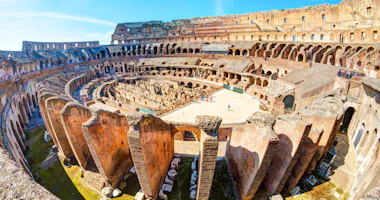
Colosseum, Roman Forum
and Palatine Hill: Skip lineColosseum, Roman Forum
and Palatine Hill: Skip lineSkip the long lines at the Colosseum with this priority-entrance ticket. This ticket will let you bypass the crowds. And after exploring the Colosseum you can head to the Roman Forum + Palatine Hill and enter directly
read more... -

Vatican Museums & Sistine Chapel: Skip The Line
Vatican Museums & Sistine Chapel: Skip The Line
Save time and stress with priority entrance and skip the line. Admire countless masterpieces by Michelangelo, Raphael, Caravaggio, Tiziano, and the Sistine Chapel.
read more... -

Borghese Gallery
Fast TrackBorghese Gallery
Fast TrackGalleria Borghese is located in Villa Borghese park. Admire the architecture and furnishings of this beautiful villa, home to a rich collection of Renaissance art, sculptures, and paintings. Get tickets weeks in advance due to limited capacity.
read more... -

St. Peter's Basilica:
Express Guided TourSt. Peter's Basilica:
Express Guided TourExperience the St. Peter’s Basilica with this express guided tour that includes reserved entrance, allowing you to bypass long lines and make the most of your time.
read more...
St Peter’s Basilica
The Papal Basilica of Saint Peter in the Vatican, officially known in Italian as Basilica Papale di San Pietro in Vaticano and commonly known as Saint Peter’s Basilica, is a Late Renaissance church located within Vatican City. The basilica is not only the main church, but also the first of the seven pilgrimage churches, in Rome.
Circus of Nero
In the first century AD, the site of St. Peter’s Basilica hosted the Circus of Nero and a cemetery. According to earliest history, St. Peter was put to death in the Circus and his remains were buried just outside. Many people remembered and visited his grave considering that he is one of the most important figures in the Roman Catholic Church. In the year 324, this prompted Emperor Constantine to begin the construction on a great basilica over the tomb. The shrine of St. Peter is still the central focus of the church today.

The original St. Peters Basilica
After 1100 years, the original St. Peter’s church was neglected and already in poor condition. There were several attempts to restore it but to no avail. In 1506, it was decided that the old basilica could no longer be saved. It was demolished to make way for a new St. Peter’s Basilica .The construction of the new St. Peter’s Basilica began on that same year with the chosen design of Donato Bramante. Bramante did not go yet beyond the four central pillars and arches of the cathedral and he died. Raphael took over his place. He had other ideas of the church and decided to work on his plans.
After Raphael, Antonio del Sangallo took care of the construction of the church. Even though he followed Raphael’s design, he wanted to take part on its edifice and he decided to break the church down and rebuild it.
Michaelangelo
Then came Michaelangelo who brought the church·back to its original design made by Bramante. Finally, Carlo Maderno built the St. peter’s Basilica further. He spread it out, so the basilica was bigger than its original design. Rich decorations covered the basilica and Gian Lorenzo Bernini made most of them. In 1626, the structure was completed.


Inside St Peter’s Basilica
Opposite the bronze gateway is a remnant of the 13th century mosaic la Navi Celli of Giotto. In the pre frontal are five bronze doors. The left door, also called the door of death, displays the image of Christ, St. Peter and Pope John XXIII. Giacomo Manzù made the door. Its name derives from its traditional use as the exit for funeral processions as well as its subject matter. The right door, also called the holy door, which is by tradition only opened for great celebrations such as Jubilee years. The door is completely bricked on the inside. The last time it was opened was when Pope John Paul II died in 2005.


At the entrance, you will find on each side two bins with cherubs. These containers are filled with holy water. At the right side, you come to see the statue of La Pietà that represents Mary with her arms around the dying Jesus Christ. Michaelangelo created La Pietà .
If you are in the middle vessel, you will see on the floor a bronze medal. These symbolize the size of other Catholic churches. In this way, only you can see how great St. Peter’s Basilica is.

Vatican Museums & St. Peter's Basilica: Fast Track Ticket + Guided Tour
Vatican Museums & St. Peter's Basilica: Fast Track Ticket + Guided Tour
The Vatican may be the smallest country in the world, but with a total of 11 museums inside the Vatican Museums, plus St. Peter’s Basilica and the Sistine Chapel, the tiny papal enclave punches well above its weight in the art world. Get immersed in all of it with this comprehensive guided tour,...

St. Peter's Basilica & Vatican Grottoes: Guided Tour
St. Peter's Basilica & Vatican Grottoes: Guided Tour
Visit St. Peter's Basilica and explore its interior, where you can see remarkable sculptures and intricate mosaics. Wander through the Vatican Grottoes, home to many papal tombs and historical artifacts. See the imposing dome that defines the skyline of Vatican City and take in the design...

St. Peter's Basilica: Audio Guide + Dome Access
St. Peter's Basilica: Audio Guide + Dome Access
Immerse yourself in the history of St. Peter's Dome with an insightful audio guide. Enjoy the breathtaking views of Vatican City and Rome while exploring the basilica's rich history. The audio guide highlights the Dome's historical significance, as well as religious and cultural heritage,...
At the crossing of the transepts is the fundamental focus of the interior, the baldacchino. It is assumed as the resting place of St. Peter. This colossal canopy shelters the papal altar and the sacred relics of St. Peter. Artistically, it also serves to fill the vertical space under Michelangelo’s great dome. At the right portion of the Bernini’s canopy is a staircase. This leads to the crypt under the church which is the cemetery for many popes.
Four huge columns hold up the dome, which has pictures of saints that stand on the pedestal of each column. These images are also on the bronze statue of St. Peter. Those who take pilgrimage in the St. Peter’s Basilica should follow the custom of kissing the apostle’s feet.
Bernini
Bernini designed the splendid gilt-bronze Cattedra di San Pietro (throne of St. Peter) in the apse above the main altar. The legs of the throne are decorated with finely pierced ivory bands made in the School at Tours.
At the left side of the transept, the tomb of Alexander VII can be found at the horizontal part of the church that crosses the nave at the canopy. Above its door was Bernini’s last work, a skeleton holding an hourglass. With this painting, Bernini wanted to express how death will come to all of us.
In St. Peter’s Basilica, there are 148 tombs of deceased popes. These are located under the nave to the crypt. The St. Peter’s Basilica has room for about 60,000 people.
Dimensions
- 395 images
- 44 altars
- 135 mosaics
- Surface 15 x 160 square meters

FAQ
-
Where is St. Peter's Basilica?
St. Peter's Basilica is located in Vatican City
-
Is St. Peter's Basilica free?
St. Peter's Basilica is free. However, there is often a long line, because of security checks. For this reason, visiting the basilica with a guide is recommended. You then enter the basilica through a separate entrance and can skip the long queue.
-
Can you visit the dome of st Peters Basilica?
You can visit the dome. This does cost entrance. Keep in mind that it is quite a climb and the stairs are narrow and steep
-
Is there a dress code for St. Peter's Basilica?
Yes, there is a dress codes. No bare shoulders, no skirts / trousers above the knee and no caps. You can possibly cover your shoulders with a shawl.
-
Who designed the St. Peter's Basilica?
Seven different architects have worked on the basilica, namely Donato Bramante, Antonio da Sangallo the Younger, Michelangelo Buonarroti, Giacomo Barozzi da Vignola, Giacomo della Porta, Carlo Maderno and Gian Lorenzo Bernini
-
How do I get to St. Peter's Basilica?
You take metro line A and get off at the Ottaviano stop. From here it is about a ten minute walk
You might also like

Vatican City Tours
There are several excursions you can book apart from the Vatican Museum. St. Peter’s Basilica and other basilicas accept visitors and tourists.
Read more...
St Peters Square
Vatican City’s gigantic square, the St. Peter's Square was built by Gian Lorenzo Bernini. The Square has two fountains that are almost identical.
Read more...
Top 5 Hotels near Vatican Trionfale
Staying in a hotel near the papal residence provides you with a breathtaking panorama of the holy city and an ambiance of sanctity.
Read more...
Rome Tours
Touring around Rome by yourself with your map at hand and just wandering around every historic corner of the city is such a pleasing and exciting experience.
Read more...