Tours
More excursions & tours-

Rome Tourist Card
Rome Tourist Card
Snap up the Rome Tourist Card and you'll get everything you need to explore Rome's top highlights including Colosseum, Palatine Hill, Roman Forum and Hop on/off bus. You can even choose the order you see things in.
read more... -
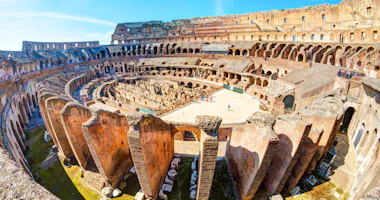
Colosseum, Roman Forum
and Palatine Hill: Skip lineColosseum, Roman Forum
and Palatine Hill: Skip lineSkip the long lines at the Colosseum with this priority-entrance ticket. This ticket will let you bypass the crowds. And after exploring the Colosseum you can head to the Roman Forum + Palatine Hill and enter directly
read more... -

Vatican Museums & Sistine Chapel: Skip The Line
Vatican Museums & Sistine Chapel: Skip The Line
Save time and stress with priority entrance and skip the line. Admire countless masterpieces by Michelangelo, Raphael, Caravaggio, Tiziano, and the Sistine Chapel.
read more... -

Borghese Gallery
Fast TrackBorghese Gallery
Fast TrackGalleria Borghese is located in Villa Borghese park. Admire the architecture and furnishings of this beautiful villa, home to a rich collection of Renaissance art, sculptures, and paintings. Get tickets weeks in advance due to limited capacity.
read more... -

St. Peter's Basilica:
Express Guided TourSt. Peter's Basilica:
Express Guided TourExperience the St. Peter’s Basilica with this express guided tour that includes reserved entrance, allowing you to bypass long lines and make the most of your time.
read more...
Mausoleum Augustus
The Mausoleum of Augustus is a·burial mound·built for Augustus and members of his family. The mound is cylindrical and is consists of four different layers. The inner circle was used as a central funereal basin. The exterior walls are covered with marble and the entrance door with bronze. In the entrance hall, you will find two obelisks and a large bronze statue of Augustus. Planted on top and at the bottom layer of the Mausoleum are the trees of death, Cypresses.
The Mausoleum of Augustus was built in 28 BC. The first to be buried here was Marcellus, Augustus’ nephew. Aside from August himself and his nephew, the Mausoleum is also the resting place of his wife Livia; his grandsons, Lucius and Gaius Caesar; and his sister, Octavia. The remains of the dead were cremated and their ashes were buried in the golden urns.

Unfortunately, due to severe vandalism and robberies there is not much left of the Mausoleum of Augustus. In the fifth century AD, the copper door was pounded. The golden urns were stolen and the ashes from inside them were discarded. Soon, the two obelisks were moved to Piazza del Quirinale and Piazza dell’Esquilino.
The Mausoleum had several functions after the looting. In the 12th century, the mound was used by the Colonna family as a fortress. Pope Gregory IX banned it in 1241. It was then used as a vineyard, an amphitheater and later as a concert hall. In 1936, Mussolini gave the order to have the mausoleum restored to its former glory. He also commissioned to build a square around the monument (now called the Piazza Augusto Imperatore).
You can find the Mausoleum of Augustus in the banks of Tiber. It was built on the edge of the Field of Mars.
Dimensions
Diameter 87 meters
Height 44 meters
Mausoleum of Augustus
Current visitor information
Checked
Plan your visit

You might also like

Monuments Rome
Rome has proven itself to be a strong city, judging by its monuments that have withstood the test of time. Not all monuments in Rome are that lucky
Read more...
Catacombs in Rome
The Catacombs of Rome are the series of prehistoric mausoleums and the underground cemetery where ancient Romans were buried.
Read more...
Quick overview hotels Rome
There are many hotels in and near the Historic Center of Rome like Colosseum, St Peter’s Basilica, Raphael’s tomb at the Pantheon and Galleria Borghese.
Read more...
Villa Borghese
Villa Borghese is a great landscape garden in Rome, containing a number of buildings, museums, and attractions. It is the second largest public park in Rome
Read more...